
Industrial Automation: AI Use Cases That Pay Off in Production
Industrial automation with AI: predictive maintenance, quality control, production planning. Sourced, measured gains, deployment organization, and ROI for industrial SMEs and mid-caps.
TL;DR : AI-driven industrial automation is no longer a trade-show promise — it is a documented production lever. Predictive maintenance can cut equipment downtime by up to 50% and maintenance costs by 10–40% (McKinsey). Vision-based quality control lifts inspection from ~80% human accuracy to 99.86% on casting parts (Sundaram et al., 2023). Smart factories gain 10–20% in production output and 7–20% in employee productivity (Deloitte). This article gives you the panorama of AI use cases in automation, the sourced, measured gains, and the method to organize deployment — from the first pilot to ROI.
260 monthly searches in France for "automatisation industrielle" (industrial automation) ([DataForSEO data, collected Aug 31, 2026]). The term is stable, driven by manufacturers looking less for a definition than for an answer to a concrete question: what can AI automate in my plant, and what does it return?
This article answers that question. It is not a technology catalog but a panorama of AI use cases in industrial automation — predictive maintenance, quality control, production planning — with sourced, measured gains, deployment organization, and the ROI logic. If you lead an industrial SME or mid-cap, you will know where to start and how to measure the return. And for the documentary side — technical documentation, tender responses, customer support — our generative AI in business guide details the use cases that pay off beyond the shop floor.
What Is AI-Driven Industrial Automation?
Industrial automation means delegating repetitive tasks and processes to technical systems. Historically it relied on programmed automata (PLCs, robots, production lines) that execute fixed rules. AI changes the nature of that automation: instead of chaining predefined instructions, an AI system understands context, adapts to exceptions, and makes decisions in cases the rules did not foresee.
Concretely, AI-driven industrial automation applies to three main families of processes:
| Family | What AI automates | Example |
|---|---|---|
| Predictive maintenance | Detecting drift before failure | Vibration analysis of a compressor |
| Quality control | Vision inspection at industrial cadence | Defect detection on an assembly line |
| Planning | Scheduling, forecasting, routing | Continuously adjusting the production plan |
These three families share a common trait: they turn data your equipment already produces (sensors, ERP, MES) into automatic decisions. That is the difference between automating for its own sake and automating to win.
AI Use Cases in Industrial Automation
Predictive maintenance: the best-documented return
This is the strongest entry point. Predictive maintenance analyzes sensor data (temperature, vibration, pressure) to anticipate failures before they occur, instead of repairing after the fact or replacing at fixed intervals.
The gains are documented by McKinsey Global Institute in its landmark Internet of Things study (June 2015): predictive maintenance can reduce equipment downtime by up to 50% and maintenance costs by 10–40% ([McKinsey Global Institute, "The Internet of Things: Mapping the value beyond the hype", June 2015]).
The cost of an unplanned stoppage is the real driver of the calculation. For a critical asset, a single avoided failure can cover the project cost. That is why predictive maintenance is the most common first use case: the return is fast, the scope is controlled (one asset, its sensors, one model), and the data often already exists. For the detailed deployment — sensors, models, failure detection, ROI — see our dedicated predictive maintenance guide.
Vision-based quality control: inspection the human eye cannot keep up with
Vision-based quality control replaces human inspection on production lines for repetitive tasks. A vision system analyzes product images in real time and flags defects with greater accuracy and cadence than the human eye — especially in electronics and automotive manufacturing.
The impact is documented by an academic study by Sundaram et al. (2023, Micromachines): manual visual inspection averages ~80% accuracy in industry, while an AI quality-control model reaches 99.86% accuracy on images of casting parts ([Sundaram et al., 2023, "Artificial Intelligence-Based Smart Quality Inspection for Manufacturing", Micromachines]).
This figure makes a key point: AI does not "do better" than a human on an isolated task — it removes the variability of attention on repetitive, high-cadence tasks. That is exactly the kind of task where AI-driven industrial automation creates measurable value.
Production planning and scheduling: AI that adjusts the plan continuously
Production planning is the newest and most strategic use case. A production plan is fragile: a breakdown, a supplier delay, an absence, or a changeover makes it obsolete within hours. AI makes it possible to recompute the schedule continuously based on real data (machine availability, inventory, maintenance constraints, team load).
Deloitte identifies advanced production scheduling as a top investment priority for manufacturers: 35% of respondents rank it among their top two investment priorities over the next two years, ahead of execution systems (33%) and quality management (28%) ([Deloitte, 2025 Smart Manufacturing Survey]).
The point is not only to optimize but to coordinate: AI learns from past outcomes — which disruptions recur, which mitigations worked — to anticipate the next disruption rather than suffer it ([Deloitte, "When the Schedule Breaks, the Factory Pays", Automation World, 2026]).
The Measured Gains of Industrial Automation
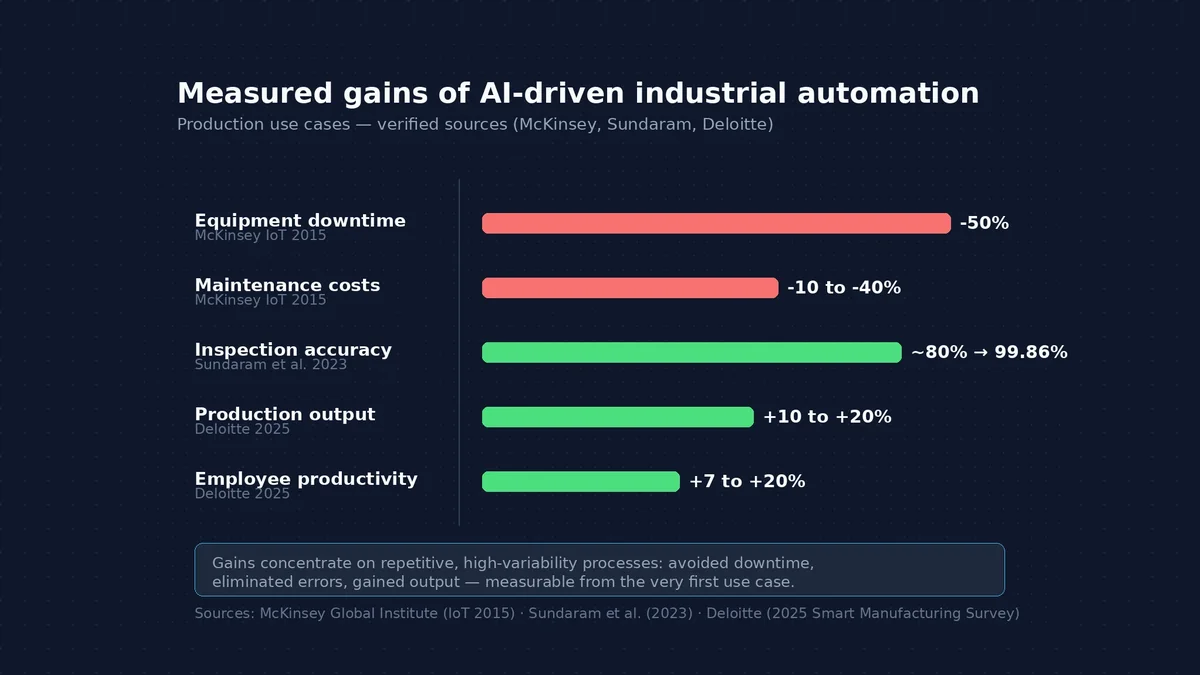
The figures below come from independent studies, verified verbatim. They give orders of magnitude — the ROI of your project is calculated on your equipment, your stoppages, your costs.
| Metric | Measured gain | Source |
|---|---|---|
| Equipment downtime (predictive maintenance) | −50% (up to) | McKinsey Global Institute, IoT 2015 |
| Maintenance costs | −10 to −40% | McKinsey Global Institute, IoT 2015 |
| Inspection accuracy (quality control) | ~80% → 99.86% | Sundaram et al., 2023 |
| Production output (smart factories) | +10 to +20% | Deloitte, 2025 Smart Manufacturing Survey |
| Employee productivity | +7 to +20% | Deloitte, 2025 Smart Manufacturing Survey |
Two lessons stand out. First, the gains are concentrated on repetitive, high-variability processes — where human error and stoppages cost the most. Second, they are measurable from the first use case: this is not a theoretical five-year ROI, but gains observed on a controlled scope.
How to Organize Industrial Automation Deployment
AI-driven industrial automation is not deployed "all at once." It is built in stages, each producing a measurable gain that justifies the next.
Step 1: Identify the high-impact process
Start by mapping your processes and spotting those that combine three criteria: high volume, repetitiveness, and high cost of error. These are the criteria that justify automation. A process handled 200 times a day with a costly error rate is a better candidate than a rare, well-controlled one. The full mapping and prioritisation method — volume × repetitiveness × cost-of-error matrix, shop-floor and back-office reservoirs alike — is detailed in our business process automation guide: this panorama covers the what (production use cases), the guide covers the how (the end-to-end method).
Step 2: Verify the data
AI is only as good as your data. Before deploying, check that the process produces usable data: sensors on the asset, failure history, quality records, ERP/MES data. If the data does not exist, producing it is the first step — often a project in itself. And if you do not know which AI systems already coexist in your business, the AI audit — a step-by-step method — gives you the starting inventory.
Step 3: Start with a quick-ROI use case
Choose a first project with high return and low risk: predictive maintenance on one critical machine, or automated quality control on one line. First results should be visible within a few months to build confidence and justify the next steps. A successful first deployment creates momentum — an over-ambitious project that fails kills it.
Step 4: Measure, then scale
Each use case serves as a reference: real cost, measured gains, observed return on investment. This is the basis on which you decide to extend to other assets, then to processes. Measurement is not a formality: it is the mechanism that turns a pilot project into an automation program.
Step 5: Govern and industrialize
Once the first cases are validated, structure the approach: AI governance (usage charter, system register, responsibilities), human supervision of decisions, and team upskilling. KPMG's Trends of AI 2026 study confirms that 60% of large French organizations have deployed cross-functional AI governance to scale AI ([KPMG, Trends of AI 2026]). Governance is not a constraint: it is the condition for industrializing without creating risk.
The ROI of Industrial Automation: What to Remember
The ROI of AI-driven industrial automation rests on three levers, all documented:
- Fewer stoppages: predictive maintenance avoids costly failures (up to −50% downtime, McKinsey).
- Fewer errors: vision-based quality control removes human variability (inspection lifted from ~80% to 99.86% accuracy, Sundaram et al.).
- More production: smart factories gain 10–20% in output and 7–20% in productivity (Deloitte).
The decisive point: ROI is measured from the first use case, not at the end of a transformation program. That is what makes AI-driven industrial automation accessible to SMEs and mid-caps — you do not fund an 18-month project, you fund a first pilot that pays off, then you scale.
FAQ
What is industrial automation? Industrial automation means delegating repetitive tasks and business processes to technical systems — and today to AI agents — wherever a measurable gain in time, quality, or compliance exists. Unlike traditional automata that follow fixed rules, AI systems understand context, adapt to exceptions, and trace every decision.
What are the AI use cases in industrial automation? Three families dominate: predictive maintenance (anticipating failures before they occur), vision-based quality control (automated inspection at industrial cadence), and production planning/scheduling (recomputing the production plan continuously). Each produces measurable, sourced gains.
What ROI can I expect from AI-driven industrial automation? Studies document up to −50% equipment downtime and −10 to −40% maintenance costs (McKinsey), inspection lifted from ~80% to 99.86% accuracy (Sundaram et al.), and +10 to +20% production output (Deloitte). ROI is measured from the first use case, on a controlled scope.
Where do I start with industrial automation? Identify the high-impact process (high volume, repetitiveness, cost of error), verify the data exists, then start with a quick-ROI use case — predictive maintenance on one critical machine or quality control on one line. Measure, then scale.
Is AI-driven industrial automation only for large companies? No. Entry costs are falling with SaaS solutions and AI APIs that don't require proprietary infrastructure. The quick-ROI pilot method makes automation accessible to SMEs and mid-caps: start small, measure, scale.
Conclusion: Industrial Automation Is Judged on Measured Gains
AI-driven industrial automation is mature. The use cases are identified — predictive maintenance, quality control, planning — and the gains are documented by independent studies: up to −50% downtime, inspection lifted from ~80% to 99.86% accuracy, +10 to +20% production output. What separates the companies that succeed is not the technology — which is accessible — but the method: identify the right process, verify the data, start small, measure, scale.
Those who start today on a reduced scope will have, in eighteen months, a data history and a documented return on investment. Those who wait will have the same cost — without the history.
👉 Contact us — Let's identify together the process where a first AI use case pays off fastest in your production.
Published August 31, 2026. Search data: DataForSEO, France, collected Aug 31, 2026. Figures from McKinsey Global Institute (IoT 2015), Sundaram et al. (2023), Deloitte (2025 Smart Manufacturing Survey), Deloitte/Automation World (2026), and KPMG (Trends of AI 2026).