
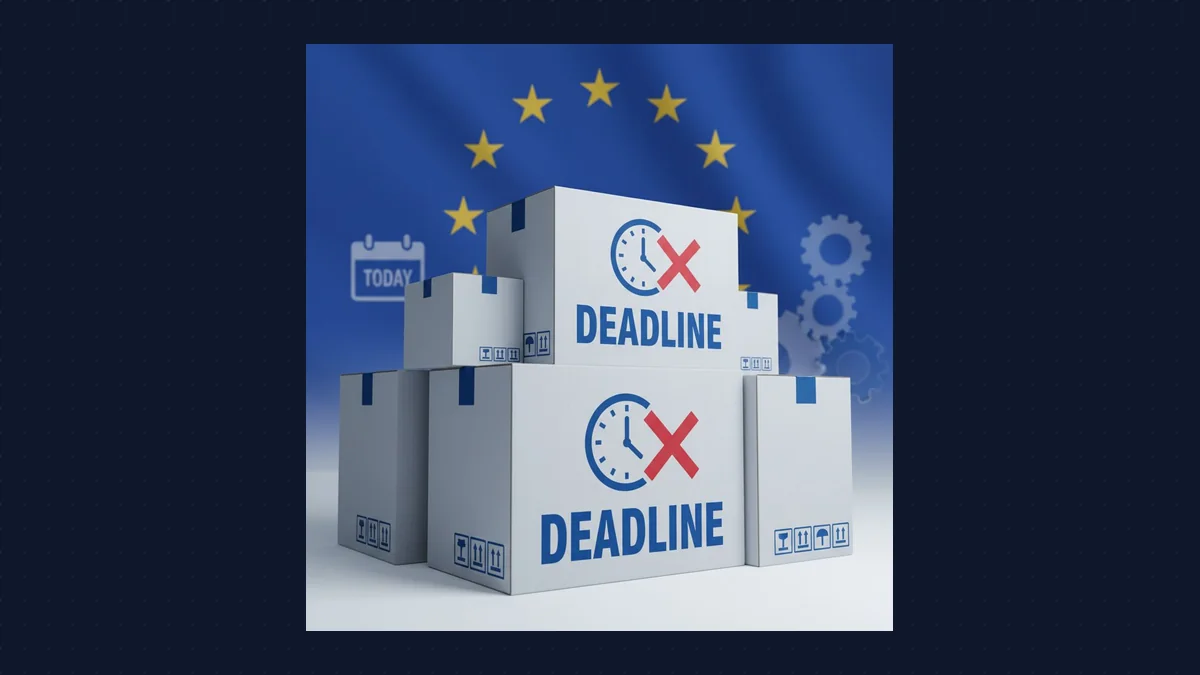
PPWR: EU Packaging Regulation Compliance Guide for Industrial Companies
The European packaging regulation took effect on August 12, 2026. Obligations, penalties, compliance: everything businesses need to know to stay on the market.
Since August 12, 2026, the European regulation on packaging and packaging waste (PPWR) has been mandatory for all companies operating in the European market. This date marked a major turning point for the packaging industry.
Did you know? Regulation (EU) 2025/40 entered into force on 11 February 2025 and became fully applicable on 12 August 2026 — no national transposition, no grace period Source: EUR-Lex.
The Omnibus did not change the PPWR. The simplification package (Directive (EU) 2026/470, in force since 18 March 2026) eased other regulations — CSRD thresholds, AI Act timeline — but left the PPWR untouched. If you have heard rumours of a postponement, disregard them: the 12 August 2026 application date was confirmed and has now passed Source: EUR-Lex.
The PPWR is not the only compliance deadline on the horizon: CSRD, the AI Act and the battery regulation each bring their own timeline. For an overview of the obligations that stack up, see our CSRD reporting and AI Act compliance guides, and our regulatory compliance page.
Why PPWR Is Critical for Your Business in 2026
The PPWR is unlike any previous packaging regulation. Unlike Directive 94/62/EC, which left room for maneuver to Member States, this regulation is directly applicable in all EU countries without national transposition.
Concrete Stakes
Since August 12, 2026, companies that place non-compliant packaging on the European market face:
- A ban on marketing their products packaged in non-compliant packaging Source: GFAW
- Administrative and financial penalties defined by each Member State, including fines, product withdrawals, and market placement bans Source: ETERNITY Systems
- Lost competitive advantage compared to competitors who anticipated the transition
Operational Requirements Starting August 12, 2026
Companies must have:
- Compliance declarations for each type of packaging placed on the European market
- Complete technical documentation tracing the entire supply chain
- Proof of recyclability for each packaging material
- Packaging data reporting system
Taranis AI Tip: Start by mapping all your packaging (primary, secondary, tertiary) before analyzing each one's compliance. This systematic approach helps identify blocking points quickly.
The 3 Mistakes to Avoid During Compliance
Mistake #1: Underestimating Timelines
Compliance timelines are real. As a rule of thumb, plan for a minimum of 4 to 6 months for complex packaging. Start now.
Mistake #2: Treating This as a Packaging-Only Problem
The PPWR impacts the entire chain: procurement, quality, legal, sales. A cross-functional approach is essential.
Mistake #3: Trying to Do Everything Alone
The standards are complex. Specialized support saves time and avoids costly mistakes.
Practical Guide: How to Comply with PPWR
Step 1: Map Your Packaging
List all your packaging references, distinguishing:
- Primary packaging (in direct contact with the product)
- Secondary packaging (grouping, protection)
- Tertiary packaging (transport, logistics)
Step 2: Verify Compliance of Each Reference
For each packaging, verify:
- Materials used
- Recycled content rate (if applicable)
- Actual recyclability
- Reuse possibilities
Step 3: Build the Compliance File
Gather:
- Official compliance declaration
- Complete technical documentation
- Supplier traceability proofs
- Certificates and attestations
Step 4: Implement Monitoring
Compliance is not a state; it's a process. Plan continuous monitoring through 2040.
Expected Results: What You'll Gain
By complying with PPWR, you will benefit from:
| Benefit | Impact |
|---|---|
| Access to the European market | Critical (blocking without compliance) |
| Enhanced brand image | Positive |
| Packaging cost optimization | 10 to 20% savings possible |
| Anticipation of future regulations | Strategic advantage |
FAQ — PPWR: Your Questions Answered
Who Is Affected by PPWR in France?
Any company placing packaging on the European market is affected, regardless of size or sector.
PPWR vs. AGEC Law: What Are the Differences?
The AGEC law is French and mainly concerns the national aspect. The PPWR is European and applies directly in all EU countries.
What Are the Penalties for Non-Compliance?
Penalties vary by Member State but can include market placement bans and significant fines.
Do I Need to Redo My Molds for PPWR?
Not necessarily. The PPWR concerns the compliance of existing packaging and new recyclability and recycled content requirements.
Conclusion
August 12, 2026, was not just another date. It marked the beginning of a new era for the packaging industry in Europe.
Companies that take this matter seriously will gain a sustainable competitive advantage. Those that wait risk facing major roadblocks.
The time for reflection is over; it's time for action.
Not sure where to start? Discuss your compliance project with our experts.
👉 Contact Taranis AI — Let's talk about your situation.
Reading time: 8 minutes
Last updated: September 18, 2026 — reflects the PPWR entering into application on 12 August 2026 and the Omnibus simplification (Directive (EU) 2026/470).