
AI Training: How to Choose the Right AI Course for Your Company
AI training: compare formats (in-person, online, in-company), selection criteria, funding (OPCO, CPF), certification and ROI. A decision guide for choosing the right AI course for manufacturing and industry.
TL;DR: Choosing an AI training course is not picking from a course catalogue — it is choosing a format, a provider and a funding route matched to a precise business objective. Demand is massive — 1,900 searches/month in France for « formation intelligence artificielle » — and the need is documented: the World Economic Forum estimates 39% of workers' core skills will change by 2030. Three formats dominate (in-person, online, in-company), each with its strengths and limits. Funding flows mainly through OPCOs and the CPF, subject to eligibility conditions. This article gives you the decision method: define the objective, compare formats, vet the provider, select the funding, and measure the return on investment.
« Formation intelligence artificielle » (AI training) is one of the highest-volume queries in the sector ([DataForSEO data, collected 31/08/2026]) — yet most Google results are course catalogues. What manufacturers are actually looking for is not a list of modules: it is how to choose the right AI training course for their teams, without picking the wrong format, provider or funding route.
This article is for leaders, HR managers and training managers of industrial SMEs and mid-cap companies. It gives you a decision framework: define the objective, compare formats, vet the provider, select the funding, and measure the return on investment. Every figure is sourced.
Why Choosing the Right AI Training Course Has Become Strategic
A massive, documented skills need
The World Economic Forum is explicit: employers estimate that 39% of workers' core skills will change by 2030 ([WEF, Future of Jobs Report 2025]). Across a representative sample of 100 workers, the WEF estimates that 29 will require training and be upskilled within their current roles, and 19 will require training and be reskilled and redeployed elsewhere in the organization by 2030 ([WEF, Future of Jobs Report 2025]).
In other words: nearly one worker in two will need training by the end of the decade. Choosing the right course is therefore not a logistical detail — it is a decision that determines the company's ability to deploy AI.
A regulatory obligation: the EU AI Act and AI literacy
Upskilling is no longer just good practice: Article 4 of the EU AI Act (Regulation (EU) 2024/1689) requires providers and deployers of AI systems to ensure a sufficient level of AI literacy for their staff and other persons operating AI systems on their behalf ([EUR-Lex, Regulation (EU) 2024/1689]).
This obligation has applied since 2 February 2025 — so it is already in force today, and it concerns all AI systems, regardless of their risk level ([European Commission, AI literacy FAQ]). It is a strong argument for moving the choice of AI training from "optional" to "structuring". We cover the regulatory framework in detail in our article on AI compliance for industry.
The Three AI Training Formats: Strengths and Limits
Choosing the format is the first decision. Each format answers a different need — there is no universal "best format", there is the format suited to your objective.
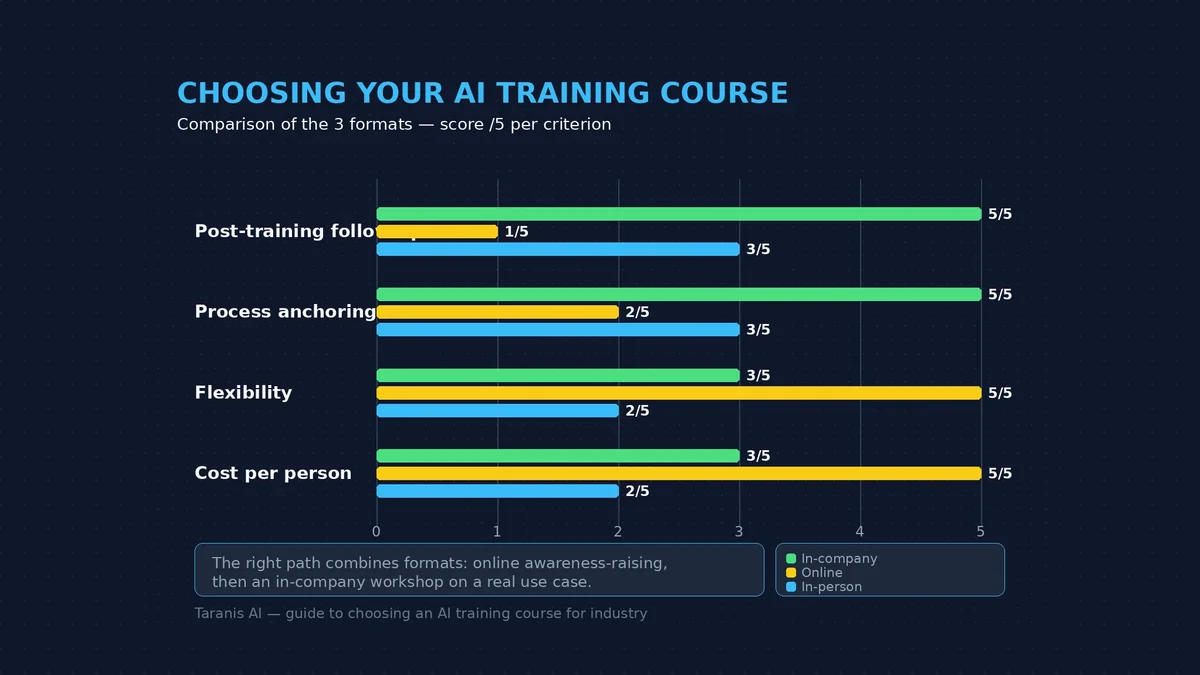
| Format | Strengths | Limits | Best for |
|---|---|---|---|
| In-person (inter-company) | Peer exchange, dedicated trainer, structured setting | High cost per person, travel, fixed dates, generic content | Awareness, acculturation, networking |
| Online (e-learning, MOOC) | Flexible, low cost, self-paced, scalable | Isolation, high dropout rate, little practice, no follow-up | Broad awareness, prerequisites, refresher |
| In-company (custom) | Content anchored on your processes and data, whole team, follow-up | Engineering cost, requires a provider able to customize | Deploying a concrete use case, operational teams |
The single-format trap is documented
McKinsey reports that in a study of Microsoft 365 Copilot adoption, nine in ten participants acknowledged that formal training would be useful, yet seven in ten ignored onboarding videos — preferring experiential and peer learning ([McKinsey, "Redefine AI upskilling as a change imperative"]).
In other words: formal training alone is not enough. The right course usually combines several formats — an online awareness module to prepare the ground, then an in-company workshop on a real use case. The decisive point is the loop: train → practice on a real case → deploy → measure → adjust. A training that does not lead to real use is a cost, not an investment.
The Selection Criteria for an AI Training Course
Beyond the format, five criteria let you compare offers and avoid the traps.
1. The measurable objective before the content
The first question is not "what content?" but "what result?". Define the measurable objective before comparing offers: reporting time reduced, unplanned stoppage avoided, document volume processed, compliance lead time. No training without an associated indicator.
2. Anchoring on your use cases
A generic "AI" course has little operational value. The right course is the one that works on your processes and your data. Check that the provider can customize the content on your use cases — not just run a catalogue.
3. The trainer's competence and proof of expertise
Check who actually trains: a trainer who has deployed AI in manufacturing does not teach like a purely academic trainer. Ask for references of real cases, documented case studies, and the opportunity to talk with the trainer before committing.
4. Certification and traceability
Two distinct questions: the provider's certification (Qualiopi, mandatory since 1 January 2022 to access public and pooled funding — OPCO, CPF, France Travail, regions) and the course's certification (anchoring to a professional certification registered in the RNCP or the Specific Register, required for CPF funding) ([ICPF, Qualiopi and CPF]).
5. Post-training follow-up
The best indicator of a good course is what happens after the training: coaching, practice workshops, indicator tracking. A training without follow-up is an event, not an investment.
Funding AI Training: OPCO, CPF and Public Schemes
Funding is often the sticking point. In France, three main channels exist — each with its own conditions.
OPCOs fund the company training plan
In France, employee training funding mainly flows through the Opérateurs de compétences (OPCOs), which manage the company training plan for companies with fewer than 50 employees. France compétences confirms that in 2024, 4.554 million training actions were initiated by companies for their employees with the support of these funds, at an average unit cost of €568 (of which €270 in pedagogical costs), with the average remaining charge to the company at 38% — rising to 67% for companies with more than 50 employees ([France compétences, Report on the use of funds 2025]).
The CPF: an individual account, with precise rules
The Compte personnel de formation (CPF) is an individual account credited in euros. For an employee working full-time or at least half-time, it is credited with €500 per year, capped at €5,000 ([Service-Public.fr, Compte personnel de formation]).
Since 2 April 2026, a mandatory flat-rate contribution of €150 applies to the employee who uses their CPF to fund a training — except for jobseekers and employees whose training is topped up by the employer ([Éditions Tissot, CPF: the out-of-pocket cost rises to €150]).
Two recent rules (2026 Finance Act, decree of 24 February 2026) frame the CPF:
- Trainings preparing for a certification registered in the RNCP are not capped;
- Trainings preparing for a certification registered in the Specific Register (RS) are capped at €1,500 of mobilizable CPF rights (except the CléA certification) ([Mon Compte Formation, new mobilization rules]).
National public schemes
The "Compétences et métiers d'avenir" (Skills and Professions of the Future) programme, part of France 2030, aims to train 400,000 people per year by 2030, according to the OECD in its review of the implementation of the European coordinated plan on AI ([OECD, France country note, 2025]). France Travail also offers a free AI awareness MOOC, "Objectif IA", open to everyone — including people in work ([France Travail]). These schemes are useful entry points for awareness; they do not replace business-specific training anchored in your processes.
How to Measure the ROI of an AI Training Course
This is the question leaders ask first — and the one course catalogues do not answer. The good news: research now documents orders of magnitude.
Targeted training increases captured value
McKinsey reports that leaders who receive the support and training needed to build new skills as AI changes their work are 3.3 times more likely to report enterprise value capture (30% versus 9%) than those who do not ([McKinsey, "From adoption to impact"]). The training → value link is direct.
Reskilling pays back its cost
McKinsey's finding on reskilling programs is clear: nearly seven in ten respondents reporting reskilling say the business impact has been greater than or equal to the investment, and 48 percent say these programs are already enhancing bottom-line growth ([McKinsey, "Beyond hiring: how companies are reskilling"]).
A four-step measurement method
- Define the measurable objective before training: reporting time reduced, unplanned stoppage avoided, document volume processed, compliance lead time. No training without an associated indicator.
- Measure the baseline: how long the process takes today, what an error costs.
- Measure after deployment: compare before/after on the same indicator, at constant scope.
- Calculate the return: measured gain × frequency − cost of training and deployment.
What not to claim
Avoid undocumented promises ("ROI in 3-6 months", "multiply value by 5"). Serious studies give orders of magnitude, not guarantees. The ROI of your training is calculated on your processes, your costs and your indicators — not on a marketing figure. That is why we systematically start with an AI audit: it identifies the highest-return use cases before you invest in training.
FAQ
Which AI training should my company choose? The one that is linked to a real use case and a measurable objective. The right sequence: identify the highest-return use cases (audit), then choose the right format (in-person, online or in-company) and train the teams concerned on those precise cases and their own tools. Training without a deployment behind it is a cost.
What is the best AI training format: in-person, online or in-company? There is no universal best format. In-person favours peer exchange, online is flexible and economical, in-company anchors the content on your processes. The right course usually combines several formats: an online awareness module, then an in-company workshop on a real use case.
Is AI training fundable by the CPF? The CPF funds eligible trainings, i.e. those anchored to a professional certification registered in the RNCP (no cap) or the Specific Register (€1,500 cap), delivered by a provider listed on Mon Compte Formation — which requires Qualiopi certification. Since 2 April 2026, a flat-rate contribution of €150 applies to the employee, except for exemptions (jobseekers, employer top-up).
Is AI training fundable by OPCOs? The company training plan is funded by OPCOs (4.554 million training actions in 2024, average cost €568 according to France compétences). The precise eligibility of an AI training depends on the branch, the company size and the provider's Qualiopi certification — to be confirmed with your OPCO.
Is Qualiopi certification mandatory for an AI training? Qualiopi has been mandatory since 1 January 2022 for any provider wishing to access public and pooled funding (OPCO, CPF, France Travail, regions). A company can fund a training from its own funds without a Qualiopi requirement, but public or pooled funding requires it.
How do I measure the ROI of an AI training? By defining a measurable objective before training (time, errors, lead times), measuring the baseline, then the state after deployment, and calculating gain × frequency − cost. McKinsey documents that targeted training makes leaders 3.3 times more likely to report enterprise value capture ([McKinsey]).
Conclusion: Choosing the Course Is Managed Like a Project
Choosing an AI training course is neither a course purchase nor a formality. It is a structuring decision: define the measurable objective, compare formats (in-person, online, in-company), vet the provider (expertise, Qualiopi, certification), select the funding (OPCO, CPF, own funds) and measure the return on investment. The orders of magnitude are documented: 39% of core skills will change by 2030, targeted training multiplies captured value by 3.3, and nearly seven in ten companies see their reskilling pay back its cost.
Those who choose the right course today will, in eighteen months, have teams that deploy — and indicators that prove it. Those who choose at random will face the same cost, without the result.
👉 Contact us — Let us identify together the use cases where AI training pays back fastest in your company, and choose the course best suited to your teams.
Article published 31 August 2026. Search data: DataForSEO, France, collected 31/08/2026. Figures from the World Economic Forum (Future of Jobs Report 2025), McKinsey & Company, the EU AI Act (EUR-Lex), the European Commission, the OECD, France compétences, France Travail, Service-Public.fr, Mon Compte Formation, the Baromètre France Num 2025 and LinkedIn.