
← Expertise / AI Audit
AI Audit
You want to deploy artificial intelligence in your business but don't know where to start. An AI audit of your processes identifies real value opportunities, quantifies the potential gains and delivers a prioritized roadmap in 6 weeks — for industry and services alike.
By Damien Godard, founder of Taranis AI · August 14, 2026
What is an AI audit?
An AI audit is a structured diagnosis of your business processes to identify where artificial intelligence delivers measurable value — and where it does nothing. An artificial intelligence audit covers four dimensions: your processes, your data, your AI maturity and your potential use cases.
Unlike a simple assessment, an AI process audit costs every opportunity: estimated time savings, error reduction, projected ROI. That is what turns the investment decision from intuition into a documented choice. For an AI audit company engagement, we work directly with your operational teams — not from a marketing slide.
The result is a complete AI diagnosis: a factual assessment of your maturity, a prioritization of use cases and an executable roadmap. It is the first step of any successful AI transformation, whatever your sector.
The Taranis method: an AI process audit in 3 steps
Map, Quantify, Prioritize: an AI diagnosis that turns complexity into an action plan.
Map
We analyze your business processes, data flows, and operational pain points to identify where AI delivers measurable value — not where it looks good on a PowerPoint slide.
Quantify
Every opportunity is costed: estimated time savings, error reduction, projected ROI. You know exactly what you stand to gain before investing a single euro.
Prioritize
We deliver an executable roadmap: which projects first, what budget, what timeline. Not a report that gathers dust — an action plan.
What You Leave With
A factual diagnosis
No jargon, no vague promises. A clear assessment of your processes, your data, and your AI maturity level.
Identified use cases
The 5 to 10 processes where AI delivers the best value/effort ratio in your specific context.
Realistic costing
Time, budget, team. Projections based on comparable deployments, not marketing slides.
A costed roadmap
Where to start, in what order, at what pace, with what projected ROI. A realistic timeline over 6 to 18 months.
How Does an AI Audit Work?
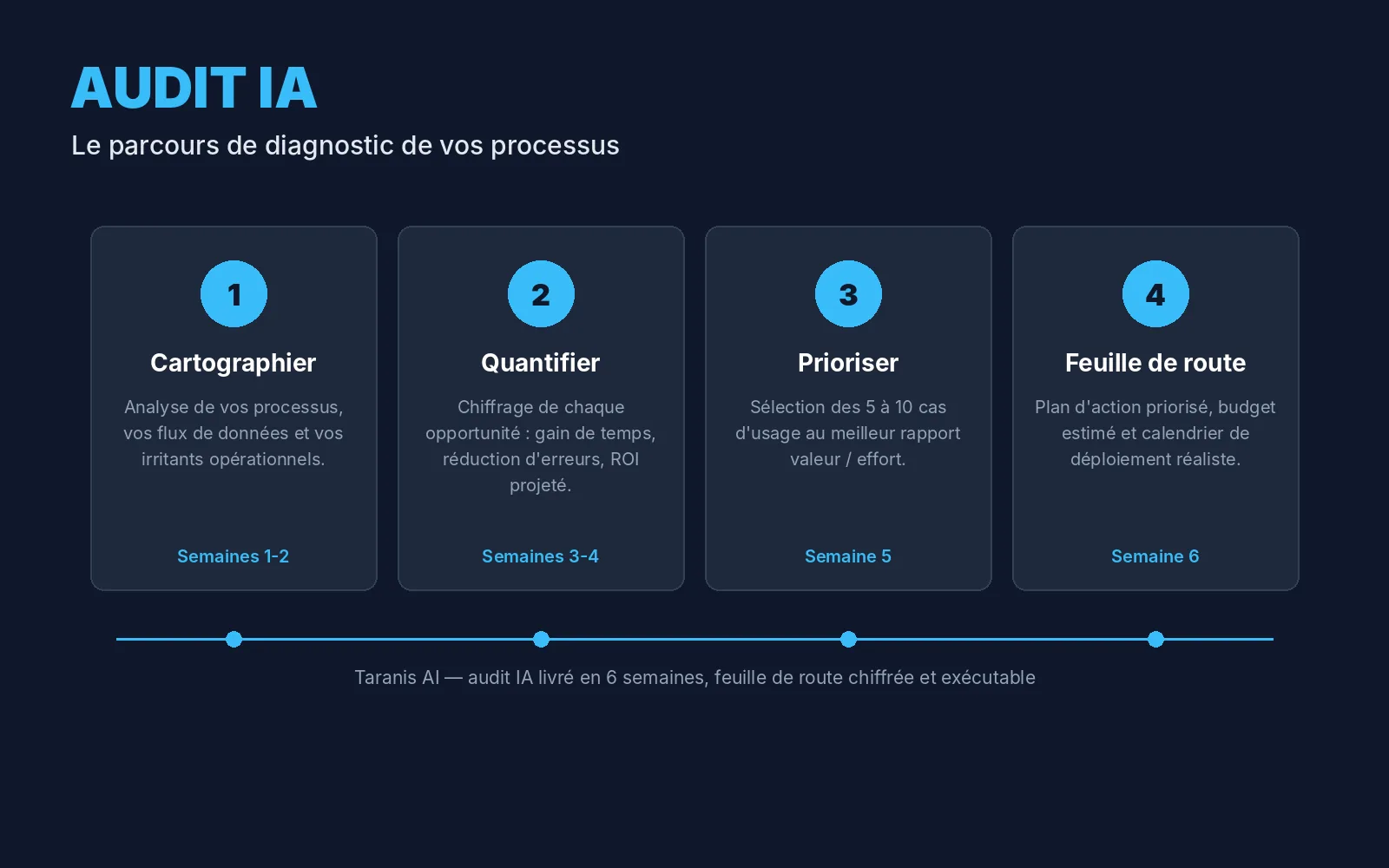
A structured 4-phase method designed to minimize impact on your production while maximizing diagnostic accuracy.
Process mapping
Our experts analyze your value chain, identify bottlenecks and repetitive tasks with high automation potential. This phase includes interviews with operational teams and an analysis of production data over at least 12 months.
AI opportunity assessment
Each process is evaluated for automation potential, estimated ROI and technical feasibility. We identify the 5 to 10 use cases where AI delivers the best value/effort ratio in your specific context.
Prioritization and costing
Use cases are prioritized and costed: time savings, error reduction, required budget, required team. You get a clear view of which projects to launch first, which to deploy next and which to drop.
Strategic roadmap
You leave with a prioritized action plan, an estimated budget per workstream, and a realistic deployment timeline over 6 to 18 months. Not a report that gathers dust — an execution plan.
Who Is It For?
Industrial companies that hear about AI every day but aren't sure if it applies to their business. You have well-oiled processes, teams that deliver, and you don't want to bet your productivity on a poorly understood technology.
Industrial leadership under pressure to “do AI” but without a clear vision of priorities. You need a structured framework to make decisions, not a list of buzzwords.
Companies that tried an AI POC that never made it past the prototype stage. We identify why it didn't work and what needs to be fixed so the next one lands in production.