
← Expertise / Industrial Automation
Industrial Automation
AI agents that execute your processes, not scripts that chain rules. We deploy autonomous systems that understand your business, adapt to exceptions, and trace every decision — for profitable industrial automation, from supply chain to administrative tasks.
By Damien Godard, founder of Taranis AI · August 14, 2026
What is industrial automation with AI?
Industrial automation is no longer limited to production lines and programmed controllers. With AI agents, it extends to the whole range of business processes: invoice processing, demand forecasting, maintenance, quality control, document management, support. Where classic RPA executes fixed rules, an AI agent understands context, handles exceptions and improves over time.
For a company, the goal is concrete: cut time spent on repetitive tasks, eliminate data entry errors, strengthen compliance and free teams for higher-value work. Process automation with AI is measured in days saved and incidents avoided — not in slides.
Industrial automation with AI agents builds on your existing systems. No IT overhaul: the agent integrates with your ERP, MES or CRM, learns your business rules and reports on every decision. That is the difference between automating for the sake of it and automating to win.
What We Automate
Six business process automation domains. Each benefit shows its source on hover or click (ⓘ): independent study or illustrative example — actual results vary with each company's context, data and scope.
Finance & Accounting
Automated invoice processing, expense reports, bank reconciliation, and purchase-to-pay cycle. The AI agent extracts, validates, and books without manual data entry.
70% time saved on supplier invoice processing, P2P cycle reduced from 12 to 5 days, 95% data entry error elimination.
ⓘSupply Chain & Logistics
Inventory optimization, demand forecasting, dynamic routing. The AI agent continuously adjusts your flows based on real data.
15 to 30% reduction in safety stock and 20% savings on transport through dynamic optimization.
ⓘPredictive Maintenance
Sensor data analysis, drift detection, intervention triggering before failure. Zero unplanned downtime.
Up to 40% reduction in unplanned downtime and 25% savings on maintenance — the agent acts before the break.
ⓘAutomated Quality Control
Computer vision, compliance analysis, quality report generation. The AI agent inspects what the human eye cannot see at industrial speed.
Inspection rate multiplied by 10, false negatives reduced by 90% compared to manual visual inspection.
ⓘDocument Management
Extraction, classification, archiving, and search of technical documents, contracts, procedures. The AI agent finds information in 3 seconds.
Search time reduced by 95% — your teams go from 2h/day to 5 min/day searching for documents.
ⓘTechnical Support & Assistance
Conversational agent connected to your technical knowledge base. Precise answers, intelligent escalation, complete history. This is also where automating administrative tasks pays off fastest.
70% of requests handled without human intervention, response time from 4 hours to 30 seconds.
ⓘAI Agents vs Classic RPA
Intelligent RPA executes. The AI agent understands, decides and reports.
Classic RPA
- Executes programmed rules, identical whatever the case.
- Stops as soon as a document deviates from the expected format.
- Does not learn: any process change requires reprogramming.
- Suited to stable, fully standardized tasks.
AI Agents (Intelligent RPA)
- Understands content and context, not just form.
- Handles exceptions and decides beyond the cases foreseen.
- Learns from your data and improves across deployments.
- Handles complex processes: compliance, maintenance, supply chain.
For business process automation, intelligent RPA is not a marketing option: it is the difference between a fragile script and an agent that holds up in production.
How to Deploy Industrial Automation
A structured journey, from POC to production, in 6 weeks.
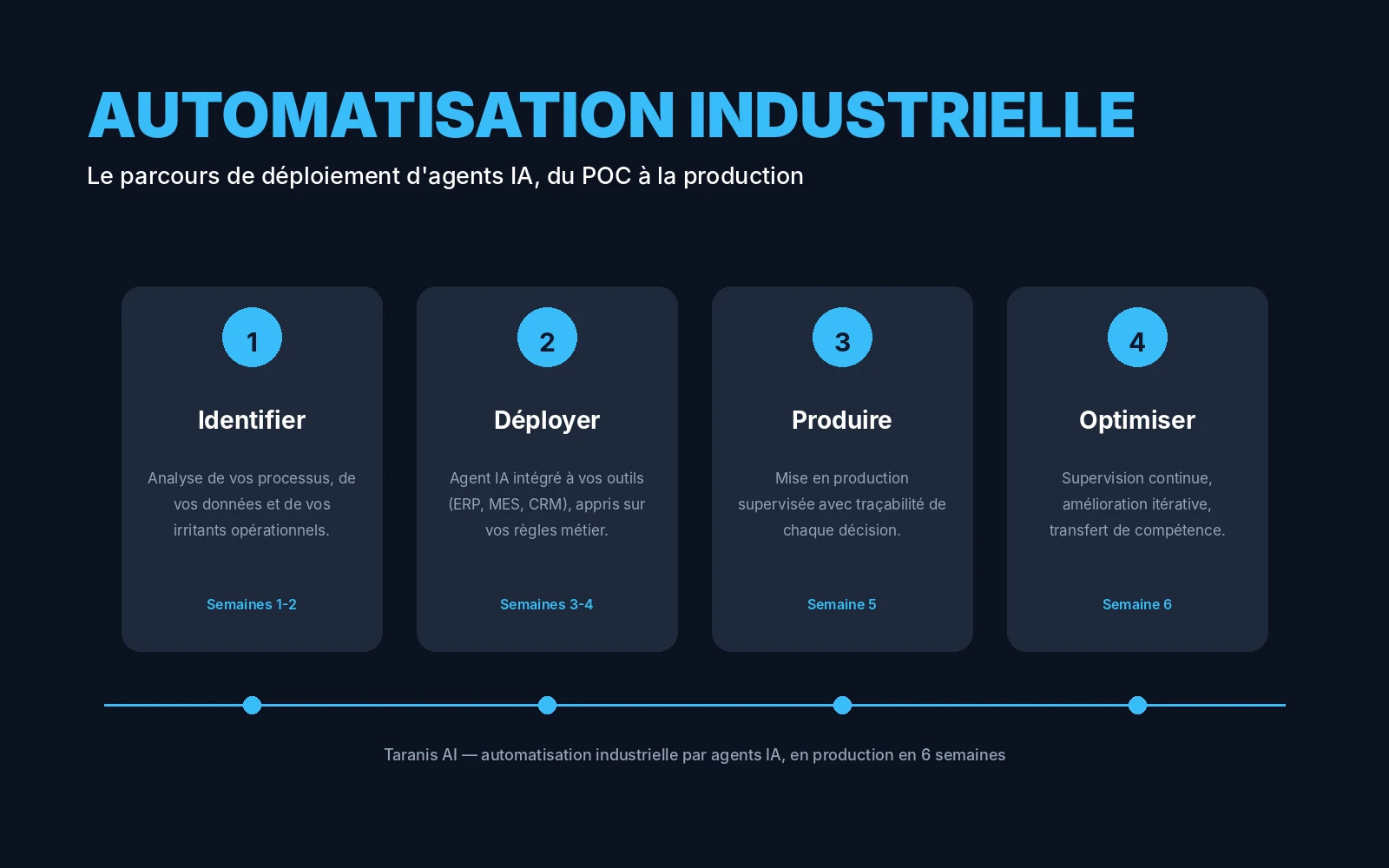
Identify the high-impact process
We target processes where volume, repetitiveness, and cost of error justify automation. No automation for automation's sake — every deployment has a measurable ROI.
Deploy a custom AI agent
We integrate the AI agent with your existing tools (ERP, MES, CRM). No need to overhaul your IT system. The agent learns your process, your data, your business rules.
Go live in 6 weeks
From the first scoping workshop to production launch: 6 weeks. We stay engaged over the long term: continuous supervision, iterative improvement, skills transfer.
Supervise and optimize continuously
The agent is monitored in production, its decisions are traced and audited. We iterate on complex cases and hand over supervision to your teams.
Typical gains
Gains documented by independent studies — sources shown on hover (desktop) or click (mobile). Non-contractual results that vary with each company's context, data and scope.
Why Taranis AI?
Not a consumer no-code tool. We deploy AI agents built for industrial rigor: full traceability, human supervision, integration with existing systems.
Not an 18-month project. 6 weeks from scoping to production. We iterate fast because we know your sector, not because we cut corners.
Not a black box. Every agent decision is documented, explainable, auditable. You stay in control — the AI executes, you supervise.