
AI Audit: A Step-by-Step Method for Your Business
AI audit: governance, data, bias, transparency. A step-by-step method to audit your systems, decide where to invest and prepare for AI Act compliance.
TL;DR: An AI audit is a structured review of your AI systems, your data and your governance — not a demonstration of the trendiest tool. It answers three questions: which systems do you use, what risks do they carry, and what should you decide first? Done properly, it steers your investment decisions, sizes your budget and prepares your AI Act compliance. Here is the method in four steps, aligned with the reference NIST AI RMF and the IIA audit framework.
You have deployed AI somewhere in your business — an agent that drafts quotes, a predictive-maintenance tool, a support chatbot, an automated quality-control workflow. Possibly several, without a central record, adopted department by department. This article does the opposite of the typical vendor catalogue: it gives you a method to audit your AI systems yourself, understand what the audit changes in practice — your decisions, your budget, your compliance — and know when to bring in a third party. Everything is sourced and aligned with the official reference frameworks.
What an AI Audit Is (and Isn't)
An AI audit is a structured review of how your AI systems behave in real operating conditions — not just how they were designed. It evaluates whether these systems produce reliable, fair and explainable outcomes, and whether those outcomes can be traced, challenged and corrected [Digital Digest, "AI Audit: Accountability and Oversight in Enterprise AI"].
In practice, a good audit examines:
| Dimension | What it looks at |
|---|---|
| Governance | Who is responsible for what? Are the roles documented? |
| Data | Where do the training data come from? Are they representative, traced, governed? |
| Bias | Are the outcomes fair across groups? Are you drifting toward discriminatory decisions? |
| Transparency | Are decisions explainable and traceable? Can a result be challenged? |
What an AI audit is not:
- A technology showcase. You are not shown the latest model; your own systems are examined, whatever they are.
- A passive stocktake. An audit quantifies and prioritises. It leads to decisions, not a report that gathers dust.
- A certification. An audit measures a state; a certification (such as ISO 42001) attests to compliance. They are two different moments, often sequential.
The international reference foundation is the NIST AI Risk Management Framework (AI RMF), published by NIST (the US National Institute of Standards and Technology) on 26 January 2023. It organises the audit around four functions: Govern, Map, Measure, Manage [NIST, AI Risk Management Framework]. This is the structure we follow below.
Why Audit: What It Changes in Practice
The most frequent question is not "how to audit" but "what's the point." Three concrete effects, in the order they appear.
1. It transforms the investment decision
Without an audit, your AI investment decisions rest on intuition and current pressure: a competitor deploys, an executive "wants to do AI", a vendor pushes its product. The audit replaces that with a documented choice: where AI delivers measurable value, and where it serves no purpose.
The figure that justifies the exercise: at least 30% of GenAI projects were abandoned after proof of concept by the end of 2025, according to Gartner, "due to poor data quality, inadequate risk controls, escalating costs or unclear business value" [Gartner press release, 29/07/2024]. The audit exists precisely to avoid launching those projects, or to launch them on the right scope.
2. It sizes the budget
An audit tells you where to put the money and where not to. It turns the budget conversation from a question of fashion ("should we invest in AI?") into a portfolio question ("which use cases do we prioritise, with what expected return?").
The pitfall to avoid is documented: Gartner predicts that through 2026, organisations will abandon 60% of AI projects not supported by AI-ready data — data aligned to a use case, governed at the asset level, supported by automated pipelines with quality gates [Gartner press release, 26/02/2025]. In other words: a better model does not rescue bad data. Auditing your data comes before investing in the model.
3. It prepares your AI Act compliance
The audit is the natural entry point to compliance. The EU AI Act (Regulation (EU) 2024/1689) is applying progressively: the transparency obligations (art. 50) have applied since 2 August 2026; the obligations for autonomous high-risk systems arrive on 2 December 2027, and those for high-risk systems embedded in regulated products on 2 August 2028 — a timetable postponed by the Digital Omnibus, in force since 27 July 2026 [EUR-Lex]. Fines can reach 7% of worldwide annual turnover for prohibited practices [Article 99, AI Act].
A documented audit is what lets you answer the first question any auditor or authority will ask: do you know what you have? Without an inventory, no risk classification; without classification, no compliance plan. For the full method, see our article AI Act 2026: AI compliance for industry.
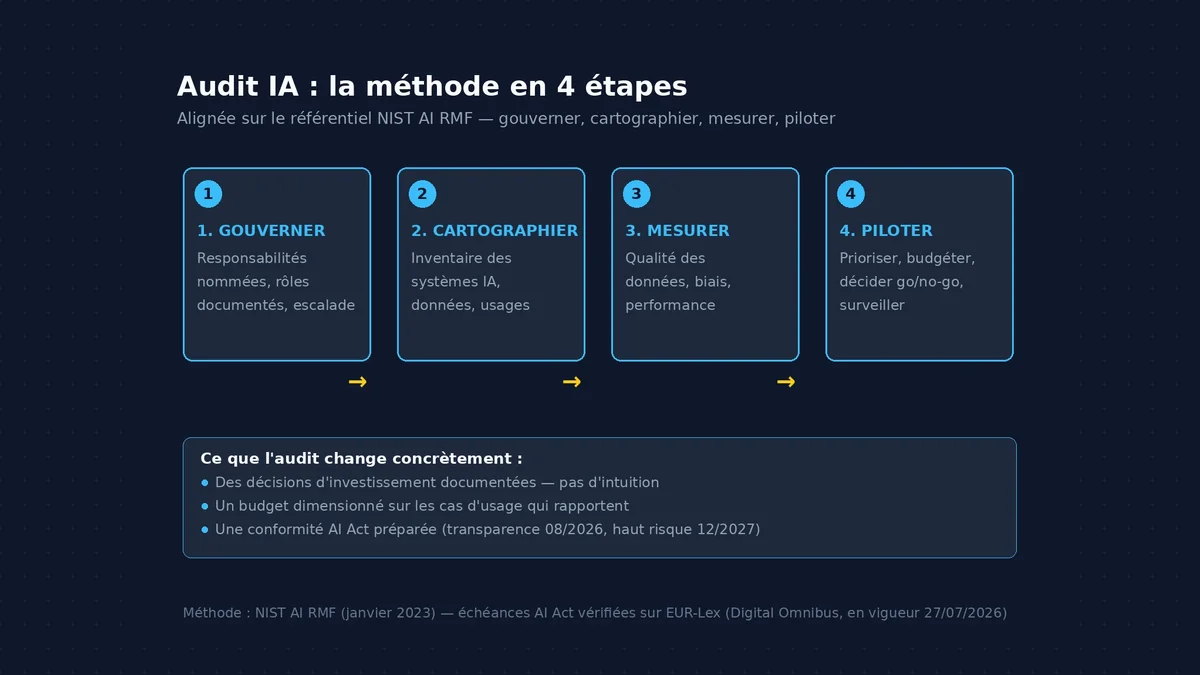
The Method in 4 Steps: Govern, Map, Measure, Manage
Step 1 — Govern: who is responsible for what
First, name the responsible people. This is the Govern function of the NIST AI RMF: "accountability structures are in place so that the appropriate teams and individuals are empowered, responsible, and trained for mapping, measuring, and managing AI risks" [NIST AI RMF, Govern 2].
Concretely:
- Appoint an audit owner — the person who holds the inventory and the process, not a phantom committee.
- Map responsibilities for each system: business owner, data owner, AI decision reviewer.
- Document escalation lines: who decides in an incident, who approves a model update.
The Institute of Internal Auditors (IIA) reinforces this point: its updated AI auditing framework describes best practices for assessing AI-related governance, management and control processes [IIA, Artificial Intelligence Auditing Framework]. Its Three Lines of Defense model — operational teams, risk/compliance functions, and independent internal audit — applies directly to AI.
Step 2 — Map: establish the inventory
This is the step most companies dread because it reveals "shadow AI": tools adopted by teams without central validation. The Map function of the NIST AI RMF consists of "identifying risks and contributing factors" [NIST AI RMF].
The inventory, system by system:
- Purpose: what the system does, which decision it influences.
- Data: what data it uses, where it comes from, whether it is representative.
- Users: who uses it, and who is affected by its outputs.
- Lifecycle: who deployed it, when, with which version.
Coming out of this step, you have the answer to "how many AI systems do you use?" — often more than you think.
Step 3 — Measure: data, bias, performance
The Measure function of the NIST AI RMF: "analyze, assess, benchmark, and monitor AI risk and related impacts" [NIST AI RMF]. Three measurements dominate.
Data. Data quality is the leading risk factor. NIST is explicit: without data governance policies, the risk of "concept drift, AI bias and discrimination" rises [NIST AI RMF Playbook, Govern]. Check: where the training data come from, whether they are representative of the real populations the system will affect, and how they are updated.
Bias. Bias appears when a system's outputs systematically disadvantage a group. The audit must answer the question NIST states in black and white: "how has the entity identified and mitigated potential impacts of bias in the data, including inequitable or discriminatory outcomes?" [NIST AI RMF Playbook, Govern]. In practice: compare error rates and outcomes across groups, test drift over time, document the metrics.
Performance in real conditions. A system that works in testing can drift in production: shifts in data distribution, concept drift, evolving usage. NIST insists on continuous monitoring: systems should be tested before deployment and regularly while in operation [NIST AI RMF Core, Measure].
Step 4 — Manage: decide, budget, monitor
The Manage function of the NIST AI RMF: allocate risk-management resources to mapped and measured risks, and treat incidents [NIST AI RMF]. This is where the audit becomes action:
- Prioritise use cases by expected gain and by risk: start with those where the data already exists and the return will be fastest.
- Decide go / no-go: some systems must be fixed, others stopped, others deployed.
- Establish monitoring: incident register, performance and bias indicators, review cycle.
The output of the audit is a costed roadmap: which systems, which gains, which risks, which costs, in which order. This is exactly what our AI audit delivers: identifying value pools, prioritising use cases and handing over a costed roadmap. The distinction is simple: this article describes the method — applicable internally with the public frameworks — while the expertise page describes the Taranis service, delivered with your teams.
Do It Yourself or Hire a Provider?
The method above can be run internally. Why, and when to stop.
Do it yourself (recommended to start). Internal audit is the best way to understand your systems and build a governance culture. The reference frameworks are public (NIST AI RMF, IIA). It is the logical first step for an SME or mid-cap company: you learn where your data and risks are before you invest.
Hire a third party (when risk or constraint demands it). Three situations justify an external provider:
- Independence: auditing a system your own team built carries a judgement bias. An external eye — NIST calls it "effective challenge," the critical questioning of design decisions by experts with the authority to make changes [NIST AI RMF Playbook] — uncovers what internal complacency masks.
- Regulatory framework: for AI Act high-risk systems, documentation and conformity assessment demand rigorous methods most internal teams do not yet have in place.
- Certification: if you target ISO 42001, a certified external body will be involved anyway — certification happens in two stages (documentation audit, then operational audit) and is maintained by annual audits [ISO 42001, our article].
Rule of thumb: start internally, externalise for independence and compliance. An internal audit gives you the vocabulary and the inventory; a provider gives you the assurance that a neutral eye has verified your conclusions.
FAQ — AI audit
How long does an AI audit take? Scope drives duration. A targeted audit of one critical system can be done in a few weeks; a full audit of an entire mid-cap company's systems takes longer. At Taranis AI, the audit runs in 6 weeks, split into 4 phases: mapping (weeks 1-2), quantification (3-4), prioritisation (5), and a costed roadmap (6) — a pace that lets you decide fast without paralysing teams.
What is the difference between an AI audit and ISO 42001 certification? An audit measures a state: which systems, which risks, which decisions. ISO 42001 certification attests to durable compliance: a documented, audited, maintained management system. The audit is often the starting point; certification is the goal for organisations that want to prove their governance externally.
Should I audit "shadow AI" systems? Yes, absolutely. Tools adopted without central validation are the first risks: no one is responsible, data is poorly governed, no controls exist. Mapping (step 2) is precisely the opportunity to register and regularise them — or stop them.
Does an AI audit really prepare you for the AI Act? The audit produces the inventory and documentation that are the starting point of any AI Act compliance: knowing what you have, classifying it by risk, documenting high-risk systems. It does not replace compliance (conformity assessment, human oversight, registers), but it is the necessary condition for it.
Do I need a provider to audit AI? Not necessarily to start: the method and frameworks (NIST AI RMF, IIA) are public. A provider becomes relevant when you need independence, regulatory rigour or a fast costed roadmap. The usual trajectory is: audit internally to learn, externalise to validate and comply.
Conclusion: an AI Audit Is Judged on the Decisions It Triggers
An AI audit is not another report. It is the instrument that turns your AI systems from a collection of scattered initiatives into a managed portfolio: named responsibilities, known data, measured bias, documented investment decisions and AI Act compliance in preparation.
The cost of an audit without a method is funding the 30% of projects abandoned after proof of concept and the 60% killed by data that was never ready — in each case, money, time and team trust. The benefit of an audit with a method is launching only what pays, and being able to prove it.
Start with the first step, the one that costs nothing: map your systems. How many AIs do you actually use, for which decisions, with which data?
👉 Request an AI audit — We map your processes, quantify the gains, prioritise the use cases and hand you a costed roadmap in 6 weeks.
Article published 24 August 2026 by Damien Godard. Method aligned with the NIST AI Risk Management Framework (AI RMF 1.0, January 2023) and the IIA audit framework; project-failure figures from Gartner (press releases of 29/07/2024 and 26/02/2025); AI Act deadlines verified on EUR-Lex (Regulation (EU) 2024/1689, Digital Omnibus (EU) 2026/1744). "AI audit" volume: DataForSEO, France, collected 24/08/2026.