
AI Training: How to Structure AI Upskilling in Your Company
AI training in business: when to train, which formats, how to measure ROI. An organizational guide to AI upskilling for manufacturing and industry.
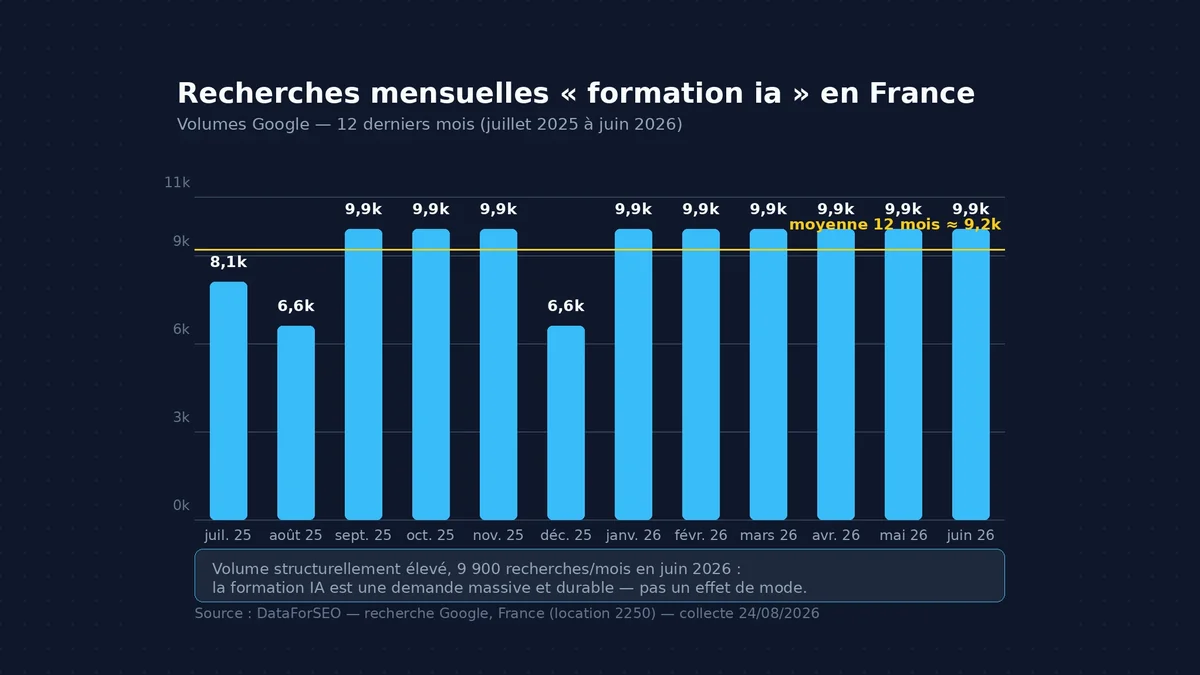
TL;DR: AI training is not buying a course catalogue — it is an organizational project. Demand is massive — 9,900 searches/month in France for « formation ia » — and the need is documented: the World Economic Forum estimates 39% of workers' core skills will change by 2030. But training without a method produces no result: the companies that measure real ROI are those that target specific roles, combine short and hands-on formats, and link training to deployed projects. This article gives you the method: when to train, in which formats, and how to measure the return on investment of AI training.
« Formation ia » (AI training) is one of the highest-volume queries in the sector ([DataForSEO data, collected 24/08/2026]) — yet most Google results are course catalogues. What manufacturers are actually looking for is not a list of modules: it is how to organize the AI upskilling of their teams so it leads to deployment, not just certificates.
This article is for leaders and HR/training managers of industrial SMEs and mid-cap companies. It gives you an operational framework: when to train, in which format, and how to prove the investment pays back. Every figure is sourced.
Why AI Training Has Become an Organizational Matter (Not a Fad)
A massive, documented skills need
The World Economic Forum is explicit: employers estimate that 39% of workers' core skills will change by 2030 ([WEF, Future of Jobs Report 2025]). Across a representative sample of 100 workers, the WEF estimates that 29 will require training and be upskilled within their current roles, and 19 will require training and be reskilled and redeployed elsewhere in the organization by 2030 ([WEF, Future of Jobs Report 2025]).
In other words: nearly one worker in two will need training by the end of the decade. This is no longer the sole concern of the training department — it is a company-level decision.
A regulatory obligation: the EU AI Act and AI literacy
Upskilling is no longer just good practice: Article 4 of the EU AI Act (Regulation (EU) 2024/1689) requires providers and deployers of AI systems to ensure a sufficient level of AI literacy for their staff and other persons operating AI systems on their behalf ([EUR-Lex, Regulation (EU) 2024/1689]).
This obligation has applied since 2 February 2025 — so it is already in force today, and it concerns all AI systems, regardless of their risk level. It is a strong argument for moving AI training from "optional" to "structuring". We cover the regulatory framework in detail in our article on AI compliance for industry.
The gap between individual and organizational readiness
The tension is well documented. According to McKinsey, 70% of respondents say they feel personally prepared to adopt AI, but only 27% of leaders believe their organization is ready to make the shifts needed ([McKinsey, "From adoption to impact"]). Training alone does not close this gap — but it is the main lever to reduce it.
When to Train: the Three Moments Where AI Training Creates Value
The question "when to train?" has one bad answer — "immediately, for everyone" — and one good one: train at the moment an AI project starts, not before, not in a vacuum.
1. Before deploying a first use case
The most profitable training is the one that prepares a concrete deployment: an agent automating a reporting flow, generative-AI supervision on technical documents, a predictive-maintenance tool. Training teams on the selected use cases — and on their own tools — turns the workshop into preparation for deployment. This is the approach we describe on our AI training for industry page: training prepares the ground that deployment then occupies.
2. At each new technology wave
Capabilities evolve fast: generative AI, then AI agents. Each paradigm shift calls for an update. The risk is training "once and for all"; the reality is that AI training is recurring — an operating budget, not a one-off project.
3. When regulation or a client requires it
The entry into force of the AI Act, a tender requiring a level of AI literacy, a certification journey (e.g. ISO 42001): these are triggers that require training traceability. In this case, training is not a strategic option but a documented compliance requirement.
Which AI Training Formats: the Right Combination
The single-format trap is documented. McKinsey reports that in a study of Microsoft 365 Copilot adoption, nine in ten participants acknowledged that formal training would be useful, yet seven in ten ignored onboarding videos — preferring experiential and peer learning ([McKinsey, "Redefine AI upskilling as a change imperative"]).
In other words: formal training alone is not enough. You need to combine several formats.
| Format | Goal | Typical duration | When to use it |
|---|---|---|---|
| Awareness / AI literacy | Understand what AI is, its uses, its limits, compliance | 0.5 to 1 day | Project kick-off, AI Act compliance, all audiences |
| Hands-on workshop on use cases | Use the tool on your own data and processes | 1 to 2 days | Before a concrete deployment |
| Coaching / practice workshops | Embed reflexes into daily work | Ongoing (weeks/months) | To move from training to real deployment |
| Dedicated AI-agents / automation training | Supervise agents, design workflows | 1 to 3 days | For technical and operational teams |
The key point is not the format itself but the loop: train → practice on a real case → deploy → measure → adjust. A training that does not lead to real use is a cost, not an investment.
How to Measure the ROI of AI Training
This is the question leaders ask first — and the one course catalogues do not answer. The good news: research now documents orders of magnitude.
Targeted training increases captured value
McKinsey reports that leaders who receive the support and training needed to build new skills as AI changes their work are 3.3 times more likely to report enterprise value capture (30% versus 9%) than those who do not ([McKinsey, "From adoption to impact"]). The training → value link is direct.
Reskilling pays back its cost
McKinsey's finding on reskilling programs is clear: nearly seven in ten respondents reporting reskilling say the business impact has been greater than or equal to the investment, and 48 percent say these programs are already enhancing bottom-line growth ([McKinsey, "Beyond hiring: how companies are reskilling"]).
These figures give the order of magnitude: a well-targeted AI training pays for itself through the deployment it makes possible.
A four-step measurement method
- Define the measurable objective before training: reporting time reduced, unplanned stoppage avoided, document volume processed, compliance lead time. No training without an associated indicator.
- Measure the baseline: how long the process takes today, what an error costs.
- Measure after deployment: compare before/after on the same indicator, at constant scope.
- Calculate the return: measured gain × frequency − cost of training and deployment.
What not to claim
Avoid undocumented promises ("ROI in 3-6 months", "multiply value by 5"). Serious studies give orders of magnitude, not guarantees. The ROI of your training is calculated on your processes, your costs and your indicators — not on a marketing figure. That is why we systematically start with an AI audit: it identifies the highest-return use cases before you invest in training.
The French Context: a Funding Ecosystem Already in Place
OPCOs fund the company training plan
In France, employee training funding mainly flows through the Opérateurs de compétences (OPCOs), which manage the company training plan for companies with fewer than 50 employees. France compétences confirms that in 2024, 4.554 million training actions were initiated by companies for their employees with the support of these funds, at an average unit cost of €568 (of which €270 in pedagogical costs), with the average remaining charge to the company at 38% — rising to 67% for companies with more than 50 employees ([France compétences, Report on the use of funds 2025]).
To be confirmed by Damien: the precise eligibility of an AI training for OPCO funding depends on the branch, the company size, available funds and the provider's Qualiopi certification. France compétences also notes that "the effects of public and pooled funding remain poorly understood". No specific "AI training" coverage rate could be verified on an official source — do not assert one without the agreement of the relevant branch.
National public schemes
The "Compétences et métiers d'avenir" (Skills and Professions of the Future) programme, part of France 2030, aims to train 400,000 people per year by 2030, according to the OECD in its review of the implementation of the European coordinated plan on AI ([OECD, France country note, 2025]). France Travail also offers a free AI awareness MOOC, "Objectif IA", open to everyone — including people in work ([France Travail]). These schemes are useful entry points for awareness; they do not replace business-specific training anchored in your processes.
FAQ
Which AI training should my company choose? The one that is linked to a real use case and a measurable objective. The right sequence: identify the highest-return use cases (audit), then train the teams concerned on those precise cases and their own tools. Training without a deployment behind it is a cost.
When should I train my teams on AI? At the moment an AI project starts — not before, not in a vacuum. Training is recurring: each new technology wave (generative AI, AI agents) and each regulatory trigger (AI Act) justifies an update.
Is AI training mandatory? Partially: Article 4 of the EU AI Act requires providers and deployers of AI systems to ensure a sufficient level of AI literacy for their staff, an obligation in force since 2 February 2025 ([EUR-Lex]).
How do I measure the ROI of an AI training? By defining a measurable objective before training (time, errors, lead times), measuring the baseline, then the state after deployment, and calculating gain × frequency − cost. McKinsey documents that targeted training makes leaders 3.3 times more likely to report enterprise value capture ([McKinsey]).
Is AI training eligible for OPCO funding? The company training plan is funded by OPCOs (4.554 million training actions in 2024, average cost €568 according to France compétences). The precise eligibility of an AI training depends on the branch, the company size and the provider's Qualiopi certification — to be confirmed with your OPCO.
Conclusion: AI Training Is Managed Like a Project
AI training is neither a course purchase nor a burden to endure. It is an organizational project: when to train (at deployment time), in which format (combined, not single), and how to measure (on concrete indicators, before/after). The orders of magnitude are documented: 39% of core skills will change by 2030, targeted training multiplies captured value by 3.3, and nearly seven in ten companies see their reskilling pay back its cost.
Those who organize upskilling today will, in eighteen months, have teams that deploy — and indicators that prove it. Those who wait will face the same cost, without the result.
👉 Contact us — Let us identify together the use cases where AI training pays back fastest in your company, and structure your teams' AI upskilling.
Article published 24 August 2026. Search data: DataForSEO, France, collected 24/08/2026. Figures from the World Economic Forum (Future of Jobs Report 2025), McKinsey & Company, the EU AI Act (EUR-Lex), the OECD, France compétences and France Travail.