
AI Training for Companies: Provider Landscape, Pricing & Selection Criteria
AI training for companies: 2026 provider landscape, real cost ranges, OPCO/CPF/IA Booster funding, 5 pitfalls to avoid. A selection guide for industrial SMEs and mid-caps.
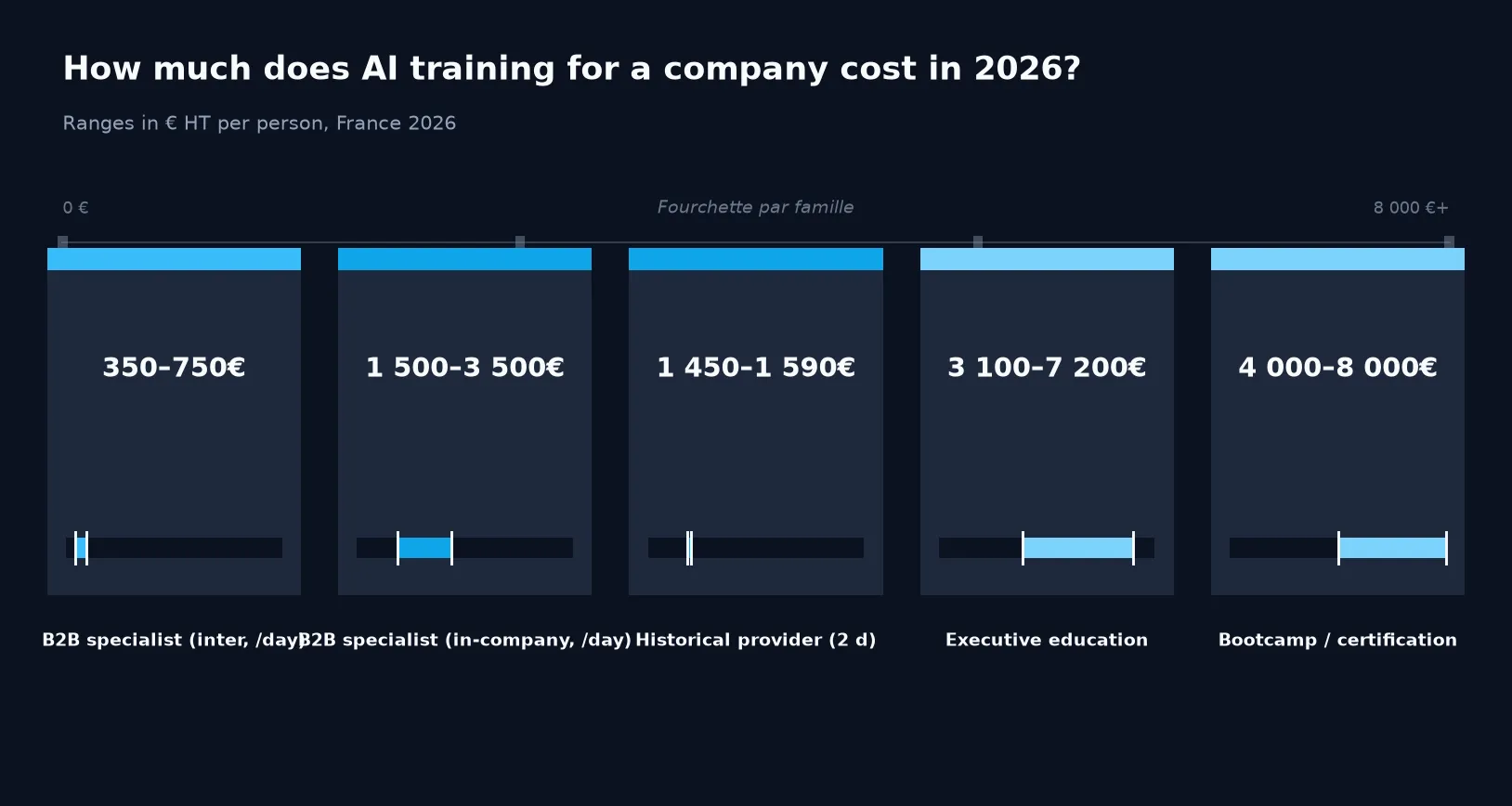
TL;DR: The French market for corporate AI training has settled into four families — business schools and executive education, B2B specialist providers (audit → training → implementation), historical training providers (large catalogue-based organisations), bootcamps and long certification tracks — with cost ranges stretching from €350 HT per person for awareness sessions to €8,000 HT for a certifying bootcamp ([GrowthPerf, 2026 pricing]; [Marketing-Management, 2025 comparison]). On the funding side, the 2026 ecosystem is dense: OPCO (French OPCO training funds, 2026 caps between €15 and €40 per hour, €1,500 to €5,000 per employee/year by branch), CPF (French individual training account, flat co-payment of €150 since 2 April 2026), IA Booster France 2030 (up to 80% coverage, €13,000 HT cap in phase 1). The right choice comes from six objective criteria — and avoiding five classic pitfalls, from the "showcase catalogue" to the "bootcamp disconnected from the workplace". For the strategic question of "when to train, in what format, how to measure ROI", see our structuring AI upskilling guide; for comparing formats before choosing, see how to choose the right AI training course.
"Formation ia entreprise" (AI training for companies) captures 480 monthly searches in France ([seo_state.json, collected 28/09/2026]) and triggers a Google AI Overview: this is a signal of structured demand, where the user is no longer looking for a course — they are looking to select a provider on objective criteria. The pages that rank for this query are mostly course catalogues or pricing comparisons, sometimes precise on price, rarely on quality criteria. A business leader of an industrial SME or mid-cap who has to sign a purchase order is looking for something different: who actually trains, at what total cost, with what out-of-pocket share, for what measurable result. This is the question this article answers.
This article is written for executives, HR directors, training managers and CFOs of industrial SMEs and mid-caps. You will find the 2026 landscape of training offers available in France, real cost ranges by family, available funding levers, and a comparison grid you can use for your next request for proposal.
The 2026 French market: four provider families, four positions
The market has settled into four main families. Each has a distinct positioning, price point and target audience — there is no "best" provider, only the provider adapted to a given objective.
1. Executive education and business schools (C-suite, leadership training)
Business schools and their short programmes target executives and C-suite: 1 to 2 days, ROI use cases, roadmap, governance. Prices range from €3,100 (HEC Paris, "Construire une stratégie Data et IA" — "Build a Data & AI strategy", 2-day programme, net price as HEC Paris is not subject to VAT) to €7,200 (École Polytechnique Executive Education, 18-hour certificate "Leading with Data and AI") ([HEC Paris, programme page "Construire une stratégie Data et IA"]; [École Polytechnique Executive Education, Leading with Data and AI]).
Reading: these programmes are out of reach for SMEs with fewer than 50 employees at catalogue price — their natural audience is mid-caps, large groups, or executive teams funded from a dedicated training envelope.
2. B2B specialist providers (industrial SMEs and mid-caps)
This is the family that matches the Taranis core segment: providers built around the "audit → training → implementation" triptych, short formats (1 to 3 days), content anchored on the client's processes. Observed price ranges go from €350 to €750 HT per person and per day for inter-company sessions, and €1,500 to €3,500 HT per day for in-company sessions ([GrowthPerf, 2026 pricing]). Examples: Matchers bills from €100 HT/hour in-company, with a "zero out-of-pocket" goal for 98% of clients via OPCO funds ([Matchers, AI training]); Custom-IA offers a 1-2 day executive programme with use case mapping ([Custom-IA, training]).
Reading: this is the segment with the best "content anchored on your processes / cost" ratio — and the only one where the training actually prepares a deployment. It is also the most heterogeneous in quality, hence the importance of the criteria grid below.
3. Historical providers (generic catalogues, Qualiopi-certified, CPF-eligible)
Cegos, ORSYS, Demos and equivalents offer modular catalogues over 1 to 2 days, Qualiopi-certified and OPCO/CPF-funded. Typical prices range from €1,450 HT (Comundi, 2-day "AI for accountants and chartered accountants") to €1,590 (Cegos, 2-day "AI for HR") ([Comundi, AI for accountants]; [Cegos, AI for HR]). The strength: traceability (Qualiopi, professional certifications); the limit: generic content, little to no anchoring on your processes.
Reading: the right use is broad awareness (AI literacy, first uses) for a large audience, or individual upskilling — not the deployment of an industrial use case.
4. Bootcamps and long certification tracks (reskilling, technical expertise)
DataScientest, Jedha, Le Wagon, OpenClassrooms and equivalents. Long format (10 weeks to several months, or 150h intensive), RNCP recognition, CPF eligibility. Observed prices range from €4,000 to €8,000 per person for a certifying path ([Marketing-Management, 2025 comparison]). The pedagogical scope is essentially technical (data science, MLOps, agent development), rarely oriented to business usage.
Reading: this is the right tool for an individual reskilling (data scientist, prompt engineer) or upskilling a technical profile — not a team training plan. Return on investment for a non-technical SME is rarely there.
Summary — 2026 landscape
| Family | 2026 range (per person) | Ideal for | Out of scope |
|---|---|---|---|
| Executive education / business schools | €3,100 – €7,200 | C-suite, mid-cap, large group | SME < 50 employees at catalogue price |
| B2B specialist (inter-company) | €350 – €750 HT / day | Process-oriented teams, deployment | Isolated individual |
| B2B specialist (in-company) | €1,500 – €3,500 HT / day | Use case deployment, full team | Broad awareness |
| Historical providers | €1,450 – €1,590 HT (2 d) | Awareness, individual upskilling | Process anchoring, deployment |
| Bootcamps / long certification | €4,000 – €8,000 | Reskilling, technical profile | Non-technical team, business use |
This landscape explains why B2B specialist providers dominate demand from industrial SMEs and mid-caps: they are the only ones combining a price compatible with an SME budget and content anchored on the client's processes.
The real cost of AI training: decompose to compare
Catalogue price is rarely the total cost. Three components must be added.
1. The gross pedagogical cost — this is the price quoted by the provider. At equivalent characteristics (duration, format, customised or catalogue), this is the most visible component — and often the most misleading, since two trainings at €1,500 can differ by a factor of three on total cost.
2. The hidden costs of an in-company training — in-company training almost systematically adds: trainer travel costs, preparation and instructional engineering (sometimes 30 to 50% of the pedagogical cost for customised work), room rental and equipment, employee time (the loaded salary of the trainee during the training, often forgotten). A leader who compares two offers at €1,500 and €2,500 HT without integrating these items may pick the more expensive option without knowing it — or the cheaper one without realising it does not include customisation.
3. The real out-of-pocket share after funding — OPCO funding at 80% does not leave 20% to pay: it leaves 20% of the pedagogical cost (and only that, not the hidden costs). For an OPCO capped at €30/hour on a 35-hour course, the coverage is €1,050 — on a €2,500 in-company pedagogical cost, the out-of-pocket is €1,450, i.e. 58% of the quote.
The complete cost of AI training for 5 people over 2 days in-company, in 2026, is typically between €4,000 and €10,000 TTC all-in — before any funding. This is the order of magnitude to keep in mind before comparing quotes.
How to compare objectively: six selection criteria
Two training catalogues at €2,000 can deliver very different results. Here are the six criteria that separate serious offers from showcases.
1. Anchoring on your use cases — does the training work on your processes, your data, your tools? A good provider accepts to co-build the programme on a scoping workshop, or maintains a documented catalogue of sector use cases (industry, production, quality, maintenance).
2. Industrial expertise of the trainer — a trainer who has deployed AI in industry does not teach like a consultant who is only certified. The useful question: "who will be in the room on D-day, and what have they worked on in the last twelve months?"
3. Qualiopi certification — mandatory for public funding. Qualiopi has been mandatory since 1 January 2022 for any provider seeking access to public and mutualised funding ([Certifopac, Qualiopi 2026]; [ICPF, 2026 funding guide]). Without Qualiopi, no CPF, no OPCO, no France Travail, no regional funding. Special case of "portage Qualiopi": since April 2024, this arrangement no longer allows access to CPF-funded training; it remains possible for other funding (OPCO, FAF, POEI, skills development plan), provided the bearer provider assumes its regulatory obligations ([Formagora, portage 2026]).
4. Traceability and professional certification — for a training to be CPF-eligible, it must be attached to a professional certification registered with the RNCP (no cap on CPF rights) or with the Répertoire spécifique (€1,500 cap on CPF rights) ([Mon Compte Formation, new rules]).
5. Post-training follow-up — the best indicator of a good programme is what happens after. A serious provider offers follow-up, hands-on workshops, and indicator tracking at 30/60/90 days. A training without follow-up is an event — not an investment.
6. Published completion rate — for remote programmes, ask for the actual completion rate on comparable audiences. Documented orders of magnitude: 2 to 10% for free MOOCs, 59% for supported verified tracks ([Harvard Gazette, HarvardX/MITx 2015 study]).
Funding AI training in 2026: OPCO, CPF, IA Booster, FNE-Formation
Funding is often the final decision point. Four channels, four logics — to be combined by format and audience.
OPCO: the team's channel, under branch caps
The OPCOs (Opérateurs de compétences) fund the skills development plan of companies, especially those with fewer than 50 employees. France compétences documents that in 2024, 4.554 million training courses were initiated by companies with the support of these funds, for an average unit cost of €568 (of which €270 in pedagogical costs), with an average company out-of-pocket share of 38% — and 67% for companies with more than 50 employees ([France compétences, 2025 funds usage report]).
2026 caps depend on the branch. Order of magnitude: hourly cap between €15 and €40 per hour per trainee (sometimes more on some OPCOs and branches) and annual cap per company of €1,500 to €5,000 per employee ([Cabinet Mosselmans, OPCO 2026]; [Akademia, OPCO 2026)]. Example: in the national metallurgy sector (IDCC 3248), the 2026 cap is €4,800 per company and per year with a €30/hour rate ([Mon Budget OPCO, 2026 scales)]. To be validated with your OPCO: scales change from one branch to another and sometimes during the year — the out-of-pocket calculation only makes sense with your own collective agreement.
CPF: the individual channel, in tightening
The Compte personnel de formation is fed at €500 per year (€5,000 cap) for a full-time employee or at least half-time ([Service-Public.fr, CPF]). Since 2 April 2026, a mandatory flat co-payment of €150 applies to the employee who uses their CPF — except for job seekers and employees whose training is topped up by the employer ([Éditions Tissot, CPF €150]); [Centre Inffo, CPF 2026]).
2026 context to integrate into your decision: in 2025, 1,226,000 trainings started via CPF, i.e. an 11% decline versus 2024 ([Dares via Cap Métiers, 2025]). CPF remains relevant for individual certification paths — it is not the tool for a synchronised team upskilling.
IA Booster France 2030: the lever for a structured AI project
The IA Booster France 2030 programme, operated by Bpifrance, targets SMEs and mid-caps with 10 to 2,000 employees and revenue > €250k. Phase 1 (approach selection) is capped at €13,000 HT with up to 80% coverage, i.e. a minimum out-of-pocket of €2,600 HT ([IAPRO, IA Booster Phase 1]); [Bloom AI, France 2030 AI 2026]. Phase 2 (deployment, multi-case) goes up to €60,000 HT with 50% coverage, i.e. a maximum out-of-pocket of €30,000 HT ([Campus Région du Numérique, IA Booster)].
Reading: IA Booster is not a training in the strict sense — it is a project-based scheme that includes a training component. It complements OPCO/CPF and targets companies that have already identified a use case to industrialise, not those discovering AI. France 2030 aids are cumulative with OPCO and FNE-Formation funding.
FNE-Formation: the "companies in difficulty / transition" lever
FNE-Formation funds training for companies in difficulty, in transition or in recovery. In 2026, priorities target the ecological transition, digital and AI, with coverage rates of 40% (large companies) to 100% (companies in difficulty with fewer than 300 employees) ([Akademia, FNE-Formation 2026]). It is a one-off channel, activated on a triggering event.
The five classic pitfalls of provider selection
Pitfall #1 — The showcase catalogue without business anchoring
A nice website, 200 modules, engaging videos — and generic content. The test: ask for a detailed programme with use cases from your sector. A provider who can customise delivers a plan in 48h. A catalogue delivers a brochure.
Pitfall #2 — The "ghost Qualiopi" or undisclosed "portage"
A non-certified subcontractor trainer who "goes through a Qualiopi-certified organisation": since April 2024, this arrangement no longer allows access to CPF-funded training. Demand the nominal Qualiopi certificate and verify its number on the French Ministry of Labour directory.
Pitfall #3 — The bootcamp disconnected from the workplace
Training a production operator to code in Python for 12 weeks will not improve their job. The bootcamp is adapted to a technical profile in reskilling — not to a production or quality team. For an AI deployment, the format that works is short training targeted on a use case, followed by field coaching (the method we apply: audit → training → agent deployment).
Pitfall #4 — The price displayed without out-of-pocket share
Comparing two quotes at €1,800 and €2,300 without reading the funding conditions. The cheapest can become the most expensive if OPCO does not fund it and CPF is ineligible. The right reflex: systematically ask for the estimated out-of-pocket share, and compare it with your branch's training budget.
Pitfall #5 — Training without impact measurement
"9 out of 10 participants satisfied" is not a ROI indicator. The documented good practice (structuring AI upskilling) is to define a result indicator (time, errors, delay) before training, and measure before/after at constant scope. McKinsey documents that leaders supported and trained in AI are 3.3 times more likely to report enterprise value creation ([McKinsey, From adoption to impact]) — but that ratio comes from targeted and supported training, not from any training.
FAQ
How much does AI training for a company cost in 2026?
For a team of 5 people over 2 days in-company, the complete all-in cost is typically between €4,000 and €10,000 TTC before funding. For inter-company awareness sessions, expect €350 to €750 HT per person and per day. For certifying bootcamps, expect €4,000 to €8,000 per person ([GrowthPerf, 2026 pricing]; [Marketing-Management, 2025 comparison]).
How to choose an AI training provider?
Six objective criteria: anchoring on your use cases, industrial expertise of the trainer, Qualiopi certification, traceability, post-training follow-up, published completion rate. The full grid and the five pitfalls to avoid are detailed in this article. In short, write down five questions to the provider before signing: sector anchoring, Qualiopi number, all-in complete cost, estimated OPCO/CPF out-of-pocket share for your branch, and a before/after result indicator.
Is AI training fundable by OPCOs?
Yes, under conditions. OPCOs fund the skills development plan with 2026 caps of the order of €15 to €40/hour and €1,500 to €5,000 per employee/year by branch ([Cabinet Mosselmans, OPCO 2026)]. Eligibility depends on your branch (IDCC code), your size, and the provider's Qualiopi certification — to be validated with your OPCO before signature.
Is AI training fundable by CPF?
Yes if attached to an RNCP certification (no cap) or to the Répertoire spécifique (€1,500 cap), delivered by a Qualiopi provider registered on Mon Compte Formation. Since 2 April 2026, a mandatory flat co-payment of €150 applies to the employee ([Éditions Tissot, CPF €150]). CPF is relevant for an individual certification path — not for a team training plan.
Should we choose a business school or a B2B provider?
It depends on the objective. For a C-suite, executive education from a business school brings legitimacy and network, at a high cost (€3,100 – €7,200 per person). For deploying a use case in an SME/mid-cap, the B2B specialist is more effective, cheaper, and anchored on your processes. For broad awareness, the Qualiopi-certified historical provider is suitable and CPF-fundable.
Does the IA Booster France 2030 programme fund training?
Not training alone, but a structured AI project. Phase 1 (approach selection) is capped at €13,000 HT with 80% coverage and includes a training component. It is the right tool for a company that has already identified a use case and seeks to industrialise it — not for an AI discovery.
Conclusion: choosing a provider is choosing a deployment partner
Choosing a corporate AI training provider is not buying a catalogue: it is choosing a transformation partner, whose value is measured by the real use made of the tools three months after the training. The 2026 landscape is readable — four families, known ranges, a dense funding ecosystem — provided you apply a grid of objective criteria and avoid the five classic pitfalls. The rule that runs through all documented cases: the training that transforms is the one targeted on a use case, funded via OPCO or IA Booster, and articulated with measurable post-training follow-up. Everything else is catalogue.
👉 Contact us — We help you qualify the right provider, structure the training plan, secure OPCO/CPF/IA Booster funding, and measure impact on your processes.
Article published on 5 October 2026. Search data: DataForSEO, France, collected 28/09/2026. Cost ranges and figures from GrowthPerf (2026), HEC Paris Executive Education, École Polytechnique Executive Education, Cegos, Comundi, Matchers, Custom-IA, Marketing-Management, France compétences (2025 report), Service-Public.fr, Mon Compte Formation, Éditions Tissot, Centre Inffo, Bpifrance / IA Booster France 2030, IAPRO, Cabinet Mosselmans, Akademia, Bloom AI, Campus Région du Numérique, Formagora, Certifopac, ICPF, the Harvard Gazette (HarvardX/MITx 2015 study) and the McKinsey "From adoption to impact" study.