
Digital Twin: Industrial Use Cases and Measured ROI
Digital twin: concrete industrial use cases and measured ROI. Predictive maintenance, simulation, automation — sourced figures and a method for SMEs and mid-cap manufacturers.
TL;DR: A digital twin — a virtual replica of an asset, a process or a site, fed in real time by its sensors — is no longer a technology showcase. The ROI data is published: 30–45% fewer unplanned stoppages, 25–30% lower maintenance costs, and a return on investment achieved in 12 to 24 months. In France, the government is investing €25 million through France 2030, and the Alliance Industrie du Futur handed a dedicated brochure to the Minister of Industry in 2025. Here are the concrete use cases, the verified figures, and the method to get started.
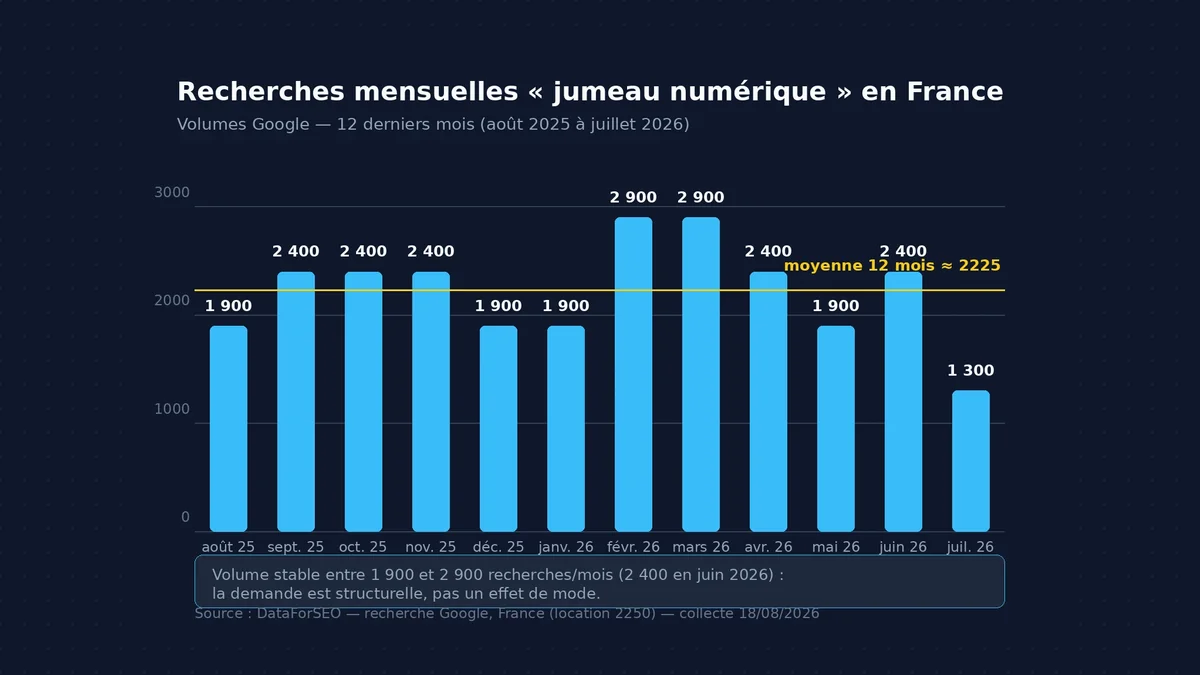
The digital twin is not a 3D mock-up. It is an industrial investment, with operating figures and a measurable return. 2,400 monthly searches in France for the term « jumeau numérique » (digital twin): more than nine times the volume of « automatisation industrielle » (260/month), one of the most closely monitored industrial queries ([DataForSEO data, collected 18/08/2026]).
Yet Google's top 10 is dominated by definition pages signed by major software publishers: AWS, Autodesk, IBM, PTC, Dassault Systèmes. No one there answers the question manufacturers actually ask: what does it return, concretely?
This article answers that question. Use cases, amounts, sources, method: everything is quantified and sourced. If you lead an industrial SME or mid-cap company, you will know where to start — and where not to start.
What an Industrial Digital Twin Is (and Isn't)
A digital twin is a virtual, dynamic replica of a physical object, process or system. Fed continuously by sensors (temperature, vibration, pressure, consumption), it simulates, analyses and predicts the behaviour of its real counterpart ([Bpifrance Le Lab — Big Média]).
The concept is not new. NASA used it in the 1960s to replicate its spacecraft on Earth; the term « digital twin » was popularised in 2010 by John Vickers, of NASA ([Bpifrance Le Lab]). What has changed over the past five years is industrialisation: cheaper sensors, mature platforms, AI able to analyse data flows.
What a digital twin is not
- A BIM model or a static 3D model. BIM (Building Information Modeling) enriches design and construction ([SNCF Réseau]). The twin, by contrast, is alive: it receives field data and returns predictions.
- A simple dashboard. A dashboard shows the current state. A twin simulates future states and compares real behaviour with expected behaviour.
The four levels of digital twin
| Level | Target | Example |
|---|---|---|
| Product | An object, throughout its life cycle | A pump, a motor, a nacelle |
| Asset | A piece of equipment in operation | A press, a production line |
| Process | A flow, an organisation | A supply chain, an assembly line |
| System | A site, a network | A whole plant, a rail network |
This classification follows McKinsey's definition: a « digital representation of a physical object, person, system or process » ([McKinsey]). The ISO 23247 standard (« Digital Twin Framework for Manufacturing ») provides the reference framework for building interoperable twins ([ISO 23247-1:2021]).
Why the Digital Twin Is Becoming the Foundation of Industrial Automation
The digital twin is the convergence point of three technologies you may already own separately: IoT (the sensors), simulation (the business models) and AI (the analysis of data flows). Brought together, they produce a capability neither offers alone: testing a decision on the virtual double before applying it to the real world.
That is exactly what industrial automation requires. An AI agent is not deployed on a production line blind. It is first validated in simulation — on the twin — then applied to the real world with known parameters, traced limits and proven fallback scenarios. The twin de-risks automation, and automation pays for the twin: it is a pair, not an option.
The market has understood this. 70% of C-suite technology executives at large enterprises are already investing in digital twins, according to McKinsey ([McKinsey, « From one twin to the enterprise metaverse »]). The firm estimates the global market at USD 73.5 billion by 2027, growing around 60% annually ([McKinsey], echoed by [StartUs Insights]). MarketsandMarkets projects USD 21.14 billion in 2025, then USD 149.81 billion in 2030 ([MarketsandMarkets]).
These projections are worth what they are worth — they are consultancy forecasts. The ROI orders of magnitude, for their part, are beginning to be documented by real operating feedback.
Concrete Use Cases and Measured ROI Figures
Predictive maintenance: the fastest payback use case
This is the most documented entry point. The Patsnap Eureka report (September 2025) synthesises published studies on digital twins applied to maintenance:
| Indicator | Observed order of magnitude | Source |
|---|---|---|
| Unplanned stoppages | −30 to −45% | [Patsnap Eureka report] |
| Maintenance costs | −25 to −30% | ibid. |
| Equipment lifetime | +20 to +25% | ibid. |
| Energy consumption | −10 to −15% (over USD 500,000/year per site in steel or chemicals) | ibid. |
| Payback period | 12 to 24 months | ibid. |
The cost of an unplanned stoppage is the real driver of the calculation: from USD 10,000 to 250,000 per hour depending on the industry ([Patsnap Eureka]). A single avoided breakdown can cover the project cost: the report cites a mid-size automotive plant that avoided USD 3.2 million in downtime in its first year, at an average stoppage cost of USD 22,000 per minute.
Production simulation: validate before you deploy
Before automating a flow, you simulate it. The process twin tests scenarios — changeovers, added machines, alternative routings — without stopping production. This is the preparatory work of any responsible automation: the twin defines the « playground » where AI agents and automation systems are tested before being put into production. This is the direct bridge to our page on industrial automation with AI agents.
Immersive training and maintenance
Twins are also used to train maintenance teams on critical equipment without risk or stoppage: technicians train on the virtual double, where error costs nothing. Field feedback (interventions, replacements) feeds the twin, which refines itself — and maintenance reports become automated.
Decarbonization and compliance
The digital twin is a decarbonization tool: it measures consumption per piece of equipment, simulates energy-efficiency gains and prepares regulatory reporting (CSRD, digital product passport). The Alliance Industrie du Futur has listed 19 concrete opportunities for the twin to combine industrial performance and reduced environmental impact (see next section). It is also a governance tool: a twin that documents asset condition and automation decisions produces the traceability required by AI regulatory frameworks — a topic covered in our article on AI compliance for industry.
What to remember from the figures
- Return on investment is documented over 12 to 24 months for maintenance twins ([Patsnap Eureka]).
- Starting budgets are accessible to SMEs and mid-caps: pilot projects sometimes launch with budgets below €50,000, with tangible results from the first months. This figure is an assertion by Olivier Audouze (Hub One) in the press — to be confirmed on your own scope ([InformatiqueNews]).
- Full industrial implementation costs range from USD 100,000 to 1 million depending on complexity ([Patsnap Eureka]). Between the two, there is a scope choice — not a grey area.
Our position is simple: do not start with the biggest possible twin. Start with the smallest one that pays. One critical piece of equipment, its sensors, a model — and a measurement.
An Active French and European Anchor
The digital twin is not an imported technology to adapt; it is an industry in which France and Europe are investing.
- Alliance Industrie du Futur: on 13 March 2025, at Global Industrie, the AIF handed the Minister for Industry and Energy (Marc Ferracci) a brochure devoted to the digital twin, listing 19 concrete opportunities for industrial performance and decarbonization ([Digital Twins for Industrial System Chair — IMT] ; [AIF brochure, PDF]).
- France 2030: €25 million of public investment to deploy territorial digital twins on a shared, sovereign platform (JUNN project, led by IGN, CEREMA and INRIA; a consortium of 14 partners by end-2026, more than 200 stakeholders engaged) ([French Directorate General for Enterprise, 17/04/2026]).
- SNCF Réseau: the MINERVE project — funded by Bpifrance under France 2030, with CentraleSupélec, Colas Rail, RATP, IREX and Kayrros — federates the railway sector's BIM and digital twin initiatives. First measured effect: €6 million in avoided rework on the EOLE site (Mantes-la-Jolie). The twin is expected to anticipate failures and support operating and maintenance decisions ([SNCF Numérique]).
- European Union: the Destination Earth programme is building digital twins at planetary scale for climate and territories ([European Commission]), and European rail is supported by the Shift2Rail programme ([SNCF Numérique]).
An industrialized digital twin in France therefore rests on a shared normative foundation (ISO 23247), public reference frameworks and funded programmes. That is a comparative advantage for SMEs and mid-caps: the method exists, the examples exist, the funding exists.
Where to Start: Five Steps to a First Digital Twin
- Choose a critical piece of equipment — the one whose stoppage costs the most (a compressor, a press, a furnace). A single asset, not a whole workshop.
- Check the data — the twin is only as good as its sensors. If the equipment is not instrumented, instrumenting it is a step in itself.
- Build a minimal model — expected behaviour curve, anomaly thresholds, failure history. No showy 3D: a useful model.
- Measure the gap — the twin compares reality with the model. Every gap detected before failure is a monetisable event (hours of avoided downtime, parts not replaced).
- Document, then extend — the first use case serves as a reference: real cost, measured gains, achieved return on investment. It is on this basis that you decide to extend to other equipment, then to processes.
This approach mirrors the one we describe for industrial automation: start from a controlled scope, measure, then scale. If you have neither the data nor the model, start with an industrial AI audit: it identifies the equipment whose data already exists and the processes where the payback will be fastest.
FAQ
What is a digital twin? A virtual, dynamic replica of a physical object, process or system, fed continuously by sensors, which simulates and predicts the behaviour of its real counterpart ([Bpifrance Le Lab]).
What is the difference between a digital twin and a 3D or BIM model? The model is static and serves design or construction. The twin is alive: it receives field data, compares reality with expectations and predicts future states. BIM can serve as a foundation for the twin — it is not one.
How much does a digital twin cost? SME and mid-cap pilot projects start around €50,000 according to published testimonials (supplier assertion, to be confirmed on your own scope — [InformatiqueNews]). Full industrial deployments range from USD 100,000 to 1 million ([Patsnap Eureka]). The cost depends on the scope: one piece of equipment, a process or an entire site.
What ROI can you expect from a digital twin? Published studies document 30–45% fewer unplanned stoppages, 25–30% lower maintenance costs, and a return on investment in 12 to 24 months for maintenance use cases ([Patsnap Eureka]). These orders of magnitude are study averages: the ROI of your project is calculated on your equipment, your stoppages, your costs.
Where do I start? One critical piece of equipment, its sensors, a minimal model, a gap measurement — then you extend. Do not start with the biggest possible twin: start with the smallest one that pays.
Conclusion: a Digital Twin Is Judged on Avoided Downtime
The technology is mature, budgets are becoming accessible, French examples exist and the figures are starting to circulate: 30–45% fewer unplanned stoppages, 25–30% lower maintenance costs, a payback in 12 to 24 months. The digital twin is no longer the « showcase » project reserved for large groups: it is a measurable operating tool, on a par with an automated line.
Those who start today on a reduced scope will have, in eighteen months, a data history and a documented return on investment. Those who wait will face the same cost — without the history.
👉 Contact us — Let us identify together the equipment or process where a first digital twin pays back fastest.
Article updated 18 August 2026. Market and ROI figures from McKinsey, MarketsandMarkets and Patsnap Eureka; French use cases from the Alliance Industrie du Futur, the French Directorate General for Enterprise (DGE) and SNCF Réseau. Search volumes: DataForSEO, France, collected 18/08/2026.