
E-invoicing in industry: AI processing, gains and ROI
Invoice dematerialization for industry: mandatory e-invoicing, AI extraction, matching, sourced gains and ROI calculation. Request an audit.
TL;DR: Since 1 September 2026, every company operating in France must receive electronic invoices — and large companies and mid-caps must issue them. Dematerialization goes beyond compliance: combined with AI (extraction, matching, control), it turns supplier-invoice processing into a measured source of gains — 79% faster cycle times and 79% lower costs among the most advanced organizations ([Ardent Partners, State of ePayables 2025]). This article gives you the end-to-end method: mandate, processing chain, sourced gains, deployment and ROI.
1,000 monthly searches in France for "dématérialisation factures" ([DataForSEO data, collected 09/21/2026]). Behind this volume lies a concrete intent: SME and mid-cap industrial leaders who must choose their platform, understand what AI changes in processing, and quantify the return — not read a legal definition.
This article answers those three questions. It complements our business process automation method — which covers the how of automation across all processes — and our industrial automation overview — focused on shop-floor use cases — by covering one specific process here, at the boundary between workshop and back office: the supplier invoice, from electronic reception to payment.
Mandatory e-invoicing: the timeline driving the change
France's business-to-business e-invoicing reform took effect on 1 September 2026 ([economie.gouv.fr]). More than 10 million economic actors are affected — the largest dematerialization reform ever undertaken in France.
| Deadline | Obligation | Companies affected |
|---|---|---|
| 1 September 2026 | Receive electronic invoices | All VAT-registered companies |
| 1 September 2026 | Issue electronic invoices + e-reporting | Large companies and mid-caps (ETI) |
| 1 September 2027 | Issue electronic invoices + e-reporting | SMEs, micro-businesses |
Three technical points structure compliance:
- Mandatory structured formats. Invoices travel in one of three recognized formats — UBL, CII or Factur-X (hybrid format) — with mandatory mentions in dedicated fields (supplier and customer SIREN numbers, dates, delivery addresses) ([impots.gouv.fr]). A plain PDF sent by email is not an electronic invoice.
- Accredited platforms. Invoices transit through an accredited platform (plateforme agréée, listed on impots.gouv.fr) — which forwards the data to the tax administration ([DGFiP reform fact sheet]).
- Mirror e-reporting. E-invoicing is completed by the transmission of transaction data to the administration, including for out-of-scope transactions (B2C, international).
The administration announces a supportive, tolerant approach for the launch phase ([economie.gouv.fr]) — but the direction is unambiguous: every industrial company will soon receive most of its supplier invoices as structured data. That is exactly the raw material automation needs.
The automated supplier-invoice processing chain
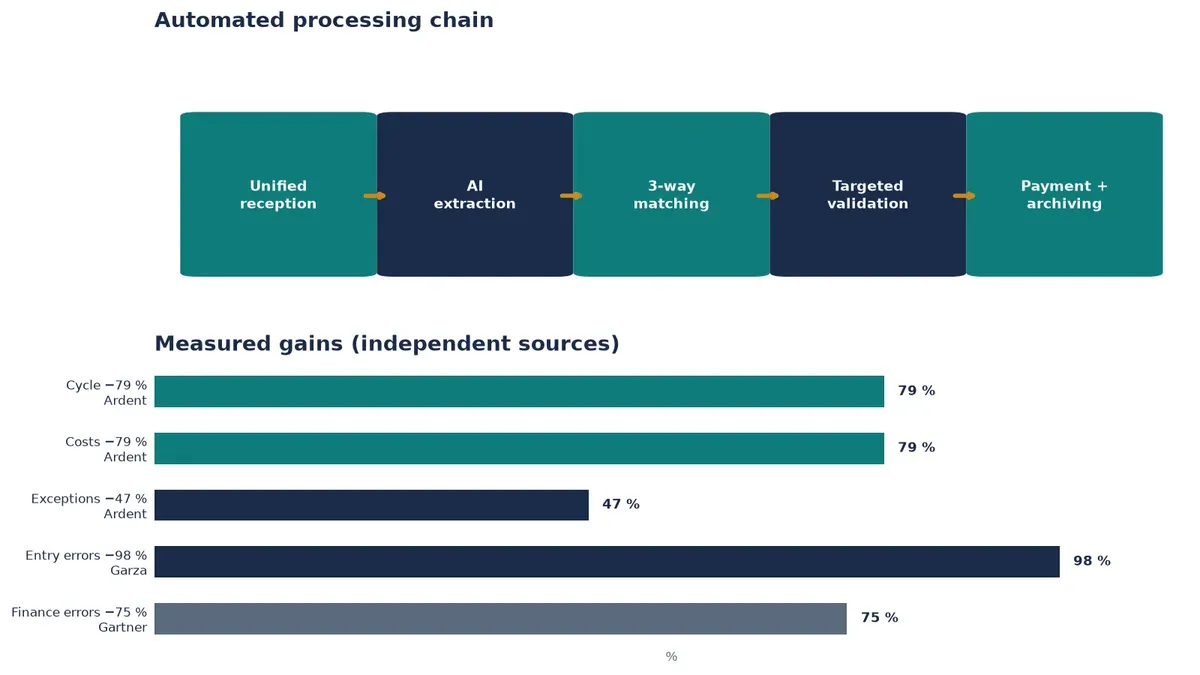
Receiving an electronic invoice is compliance. Processing it without re-entry, matching it automatically against the order and the goods receipt, involving humans only on exceptions: that is automation. Five steps, from inbound flow to payment.
Step 1: unified reception and capture
All invoices arrive in one place: the accredited platform centralizes structured electronic invoices, while residual invoices (paper, unstructured PDFs from foreign suppliers) are scanned and OCR-processed. The administration itself highlights the benefit: a single storage location for all invoices, replacing today's scattered channels (mail, email, supplier portals) ([economie.gouv.fr]). For a plant receiving hundreds of materials, subcontracting and maintenance invoices each month, this centralization eliminates lost invoices and duplicates at a stroke.
Step 2: AI-powered data extraction
This is where AI changes everything. Document-understanding models read each invoice — line items, amounts, VAT, order references, payment terms — including layouts never seen before. The Garza et al. (2023) meta-analysis documents the effect on entry quality: an error rate dropping from 6.57% to 0.14% in automated tasks, i.e. −98% ([Garza et al., 2023]). And organizations that digitize with high technology acceptance record 75% fewer financial errors ([Gartner, February 2024]).
Step 3: automated three-way matching
In industry, an invoice is not paid — it is matched. The system automatically reconciles the three documents — purchase order (prices and quantities ordered), goods receipt (quantities delivered, quality control) and invoice (amounts billed) — and escalates only variances: different price, short delivery, pending quality receipt. The most advanced organizations thus process 1.8 times more invoices straight through, with no human touch ([Ardent Partners, State of ePayables 2025]). This is the junction with production: matching reads shop-floor data (receipts, rejects, quality credits).
Step 4: targeted validation workflow
Only exceptions reach a human: price variance beyond threshold, invoice without order, new supplier, unusual amount. The workflow routes each case to the right approver (buyer, workshop manager, accountant) with the complete file — invoice, order, receipt, supplier history. Everything else is approved automatically under configured rules. This targeting explains most of the time savings: humans no longer process 100% of invoices, but the 10 to 20% that warrant it.
Step 5: payment, archiving and control
The validated invoice goes to payment on optimized terms (discounts, supplier lead times), is archived electronically with its audit trail, and feeds dashboards: average processing times, exception rates per supplier, amounts in dispute. The loop closes: billing data becomes purchasing-control data — actual supplier lead times, recurring price variances, delivery quality.
The measured gains of invoice dematerialization
Every figure below comes from independent studies, verified verbatim. These are orders of magnitude observed across comparable organizations — your return is calculated on your volumes and costs.
| Measured gain | Magnitude | Source |
|---|---|---|
| Invoice processing times (best-in-class vs others) | 79% faster | Ardent Partners, State of ePayables 2025 |
| Per-invoice processing cost (best-in-class vs others) | 79% lower | Ardent Partners, State of ePayables 2025 |
| Invoice exception rate (best-in-class vs others) | 47% lower | Ardent Partners, State of ePayables 2025 |
| Data-entry errors (automated tasks) | 6.57% → 0.14% (−98%) | Garza et al., 2023 |
| Financial errors (digitized environments) | −75% | Gartner, February 2024 |
| Data collection and validation time | −60 to −80% | Forrester, TEI July 2022 |
| Compliance reporting cost and speed | 80% cheaper, 3× faster | McKinsey, November 2023 |
Ardent Partners' global benchmark also gives the average starting point: 8.2 days and $9.84 per invoice processed — the baseline against which any company can estimate its opportunity ([Ardent Partners, State of ePayables 2025]).
Typical scenario (illustrative case study — illustrative, non-contractual figures): a 120-person industrial SME processes 400 supplier invoices a month, with two days a week of manual re-entry and matching. It deploys AI extraction and automatic matching on its three main flows (materials, subcontracting, maintenance): clean cases go straight through, and the accountant only handles exceptions. This scenario illustrates the approach; your gains are measured on your volumes, errors and actual costs.
Deploying invoice dematerialization: the 5-step method
Step 1: measure the current flow
Count your monthly invoices by channel (paper, PDF, portals, structured electronic), measure end-to-end processing time and the exception rate. Without this snapshot, no ROI is credible — and it sizes the project. If your document flows are scattered across departments with no central inventory, start with an AI audit.
Step 2: choose the accredited platform as foundation
Compliance requires choosing an accredited platform before 1 September 2026 for reception — make it the foundation of processing, not a mere regulatory pipe. Selection criteria: connection to your ERP and accounting, handling of residual unstructured invoices, built-in or interfaced AI extraction API, statuses and timestamps usable for control.
Step 3: start with a pilot on a controlled flow
Pick a high-volume, stable-rules flow — e.g. materials invoices with systematic orders — and deploy extraction + automatic matching on that scope alone. The first result must be visible within months: straight-through rate, time saved, errors eliminated. As with any process, the rule holds: a pilot that pays before a program that promises (see our business process automation method).
Step 4: extend to complex flows and production
Once the pilot is validated, extend: subcontracting invoices (matched to work orders), maintenance invoices (matched to interventions), quality credits (linked to shop-floor non-conformities). At this stage the invoice joins production: matching reads receipts, controls and rejects — the same data as industrial automation.
Step 5: govern — thresholds, roles, skills
Set exception thresholds, designate approvers, train accounting and purchasing to supervise the system rather than key in data. Successful dematerialization does not remove human control: it moves it from 100% of invoices to the 10–20% carrying risk or a decision.
Invoice dematerialization ROI: how to calculate it
ROI is calculated invoice by invoice, across three levers:
- Time recovered: (manual time per invoice − supervised time per invoice) × annual volume × loaded hourly cost. With an average 8.2-day processing time and 79% faster cycles among advanced organizations, this is the most direct lever — documented by Ardent Partners and, on data collection, by Forrester (−60 to −80%).
- Errors and disputes avoided: (error rate before − error rate after) × annual volume × average cost per error (rework, late penalty, lost discount, duplicate payment). See Garza (−98% data-entry errors) and Gartner (−75% financial errors).
- Optimized cash flow: discounts captured through faster approvals, supplier terms met without penalties, disputes settled sooner. This is the lever unique to invoicing — no other back-office process touches cash flow so directly.
The decisive point: the regulatory mandate funds part of the foundation (platform, formats, archiving). The extra cost of automation — AI extraction, matching, workflows — is judged against the three levers above, measured on your actual flow from the pilot onward. Beware of payback-in-weeks promises: the gains documented by independent studies are observed on methodically run deployments.
FAQ
What is the mandatory e-invoicing deadline? Since 1 September 2026, all VAT-registered companies must receive electronic invoices; large companies and mid-caps must also issue them. SMEs and micro-businesses must issue in electronic format from 1 September 2027 ([economie.gouv.fr]).
E-invoicing vs invoice dematerialization: what is the difference? E-invoicing is the regulatory obligation: issuing and receiving invoices in structured formats (UBL, CII, Factur-X) via an accredited platform. Invoice dematerialization is the complete approach: unified reception, AI extraction, automatic matching, targeted validation, archiving and control. The former is the foundation of the latter.
Which formats are accepted for e-invoices? The three recognized formats are UBL, CII and Factur-X (hybrid format combining structured XML data with a readable representation), with mandatory mentions in dedicated fields ([impots.gouv.fr]). A plain PDF sent by email does not qualify as an electronic invoice.
How long does it take to automate invoice processing? A pilot on a controlled flow (extraction + matching) delivers its first measured results within months. Extension to complex flows and integration with production data follow once the pilot is validated. Measuring the pilot — straight-through rate, time saved, errors eliminated — conditions everything after.
How do you calculate invoice dematerialization ROI? Across three levers: time recovered (volume × time delta × hourly cost), errors avoided (rate delta × error cost) and cash flow (discounts, penalties avoided). Independent-study benchmarks — Ardent Partners (−79% costs and cycle times), Garza (−98% entry errors), Gartner (−75% financial errors) — frame the estimate; your ROI is calculated on your actual volumes.
Conclusion: the mandate as starting point, not ceiling
Mandatory e-invoicing brings every industrial company into dematerialization — willing or not. Companies that stop at compliance will pay for the foundation without harvesting the returns. Those that add AI extraction, automatic matching and targeted validation turn a regulatory constraint into a measured source of gains: 79% faster cycles, 79% lower costs, divided errors — and better-managed cash flow.
Already receiving electronic invoices and still re-keying them? Request an audit — we measure your current flow and quantify the return of a first pilot on your actual data.
Article by Damien Godard, founder of Taranis AI. Research data: DataForSEO, France, collected 09/21/2026. Figures from Ardent Partners (State of ePayables 2025), Garza et al. (2023), Gartner (2024), Forrester (TEI, 2022) and McKinsey (2023); timeline and formats: economie.gouv.fr, impots.gouv.fr, DGFiP. Companions: the business process automation method and the industrial automation overview.