
Business process automation: AI and RPA method for industry
Business process automation in industry: mapping, production and back-office use cases, sourced gains and ROI method. Request an audit.
TL;DR: Business process automation is not about "putting AI everywhere" — it means mapping your business processes, selecting those where volume, repetitiveness and cost of error justify the investment, then deploying through measured pilots, on the shop floor as well as in back-office functions. The gains are documented: up to −50% equipment downtime (McKinsey), −98% data-entry errors (Garza et al., 2023), 60 to 80% of data-collection time saved (Forrester). This article gives you the end-to-end method: mapping, use cases, sourced measured gains, deployment and ROI.
320 monthly searches in France for "automatisation des processus" ([DataForSEO data, collected 09/14/2026]). Behind this volume lies a clear intent: SME and mid-cap industrial leaders looking not for a definition, but for a method — which process to start with, with which tool, and for what return?
This article answers that question. It complements our overview of AI use cases in industrial automation — which covers what AI automates on the shop floor — by covering the how: the end-to-end process method, from mapping to ROI, for workshops and offices alike. If you run an industrial company, you will know which processes to automate first, in which order, and how to measure the return.
Business process automation: what are we really talking about?
A business process is a sequence of steps turning an input into an outcome: processing a customer order, qualifying a quality defect, issuing an invoice, scheduling a production run. Business process automation means entrusting all or part of these steps to technical systems — with a single objective: a measurable gain in time, quality or compliance.
Three technologies combine — not to be confused:
| Technology | What it does | When to use it |
|---|---|---|
| RPA (robotic process automation) | Replays human actions on existing applications, following fixed rules | Stable, structured, high-volume processes (data entry, reconciliations, exports) |
| AI (vision, prediction, language) | Understands context, handles uncertainty, adapts to exceptions | Non-standard documents, images, sensor signals, free text |
| AI agents | Chain several steps autonomously, with human supervision | Cross-functional processes mixing rules and decisions (order handling, dispute management) |
In industrial practice, it is the combination that creates value: RPA executes, AI understands, the agent orchestrates. A 100%-rules process needs only RPA; as soon as there are exceptions, varied documents or decisions, AI becomes necessary. That is why the first step is never the tool — it is mapping.
Map your processes before automating
Automating a poorly understood process means industrializing disorder. Mapping means describing, for each candidate process: its steps, its actors, its volumes, its exceptions and its cost of error. This work takes a few days per process — and determines the entire return.
The three selection criteria
A process is a good automation candidate when it combines three characteristics:
- High volume: handled dozens or hundreds of times per day, week or month. Frequency is what pays back the investment.
- Repetitiveness: stable steps, explicit rules, known and classifiable exceptions. The more standard the process, the more reliable the automation.
- Significant cost of error: an entry error, a missed check or a delay that costs real money — scrap, penalties, rework time, compliance risk.
The resulting prioritization matrix is simple: first, processes with high volume, high repetitiveness and high cost of error; last, rare, variable and well-mastered processes — better left to humans.
| Priority | Volume | Repetitiveness | Cost of error | Example |
|---|---|---|---|---|
| P1 — automate first | High | High | High | Order entry, series quality control, invoice processing |
| P2 — automate next | Medium | High | Medium | Production reporting, supplier follow-ups |
| P3 — assist, don't automate | Low | Variable | High | Complex dispute handling, investment decisions |
This mapping is done with the teams who run the process — never without them. Operators, technicians and accountants know the real exceptions, the ones in no written procedure. A half-day mapping workshop per process is enough in most SMEs.
Which processes to automate in industry: shop floor and back office
The most common mistake is automating only production and forgetting the offices — or the reverse. Both reservoirs complement each other, and it is often the back office that funds what comes next.
On the shop floor: build on documented use cases
On the workshop side, the strongest use cases are known and quantified: predictive maintenance on critical equipment, vision-based quality control, continuously recalculated planning and scheduling. They are detailed — with measured gains — in our overview of industrial automation, and predictive maintenance has a dedicated guide (sensors, models, failure detection, ROI). For a first shop-floor pilot, the rule stands: one critical asset, data that already exists, a gain visible within months.
The documented stake is massive: Deloitte finds smart factories gaining 10 to 20% in output and 7 to 20% in employee productivity ([Deloitte, 2025 Smart Manufacturing Survey]). And advanced scheduling ranks among the top two investment priorities for 35% of industrial respondents — ahead of execution systems and quality management.
In back-office functions: the underestimated reservoir
On the office side — accounting, purchasing, sales administration, document quality, reporting — processes are often simpler to automate than on the shop floor: data already digital, explicit rules, high volumes. Four families stand out:
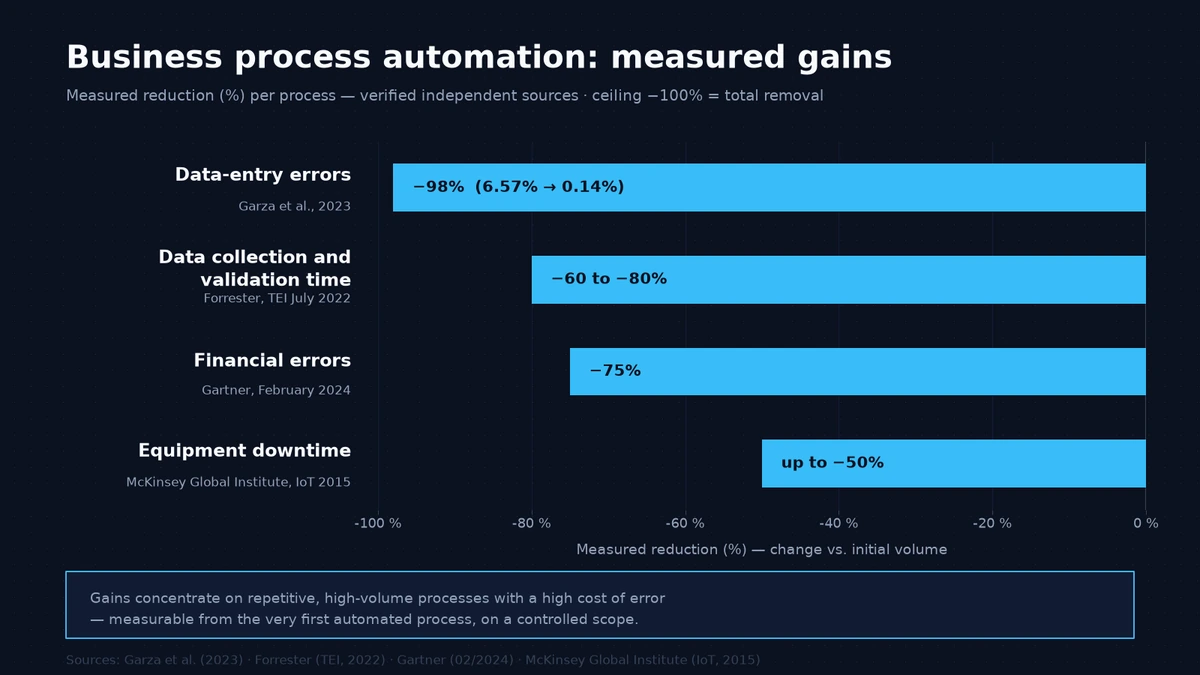
- Document entry and processing: supplier invoices, purchase orders, quality records. The Garza et al. (2023) meta-analysis documents an error-rate reduction from 6.57% to 0.14% (−98%) in automated entry tasks ([Garza et al., 2023]).
- Data collection and consolidation: production reporting, sustainability reporting, dashboards. Organizations surveyed by Forrester estimate saving 60 to 80% of data collection, validation and sharing time with a dedicated solution ([Forrester, Total Economic Impact™ of Diligent ESG, July 2022]). And McKinsey documents cloud CSRD reporting solutions 80% cheaper and 3 times faster than manual approaches ([McKinsey, Cloud-powered technologies for sustainability, November 2023]).
- Customer relations and support: request qualification, routine answers, dispute follow-up. Gartner predicts agentic AI will autonomously resolve 80% of common customer service requests without human intervention by 2029 ([Gartner, March 2025]).
- Financial reliability: organizations that digitize with high technology acceptance see 75% fewer financial errors ([Gartner, February 2024]).
Typical scenario (illustrative case study — illustrative figures, non-contractual): a 300-person mid-cap maps 12 processes and selects 3 as P1 (manufacturing order entry, supplier invoice processing, weekly production reporting). The first pilot — invoice processing — serves as the quantified reference before extending to the other two. This scenario illustrates the method; your gains are measured on your real volumes, errors and costs.
The measured gains of business process automation
Every figure below comes from independent studies, verified verbatim. These are orders of magnitude — your project's ROI is computed on your processes, volumes and costs.
| Process | Measured gain | Source |
|---|---|---|
| Equipment downtime (predictive maintenance) | up to −50% | McKinsey Global Institute, IoT 2015 |
| Maintenance costs | −10 to −40% | McKinsey Global Institute, IoT 2015 |
| Data-entry errors (automated tasks) | 6.57% → 0.14% (−98%) | Garza et al., 2023 |
| Data collection and validation time | −60 to −80% | Forrester, TEI July 2022 |
| Financial errors (digitized environments) | −75% | Gartner, February 2024 |
| Routine requests resolved without intervention (by 2029) | 80% | Gartner, March 2025 |
| Output (smart factories) | +10 to +20% | Deloitte, 2025 |
| Employee productivity | +7 to +20% | Deloitte, 2025 |
Two lessons emerge. First, gains concentrate on repetitive, high-volume, high-error-cost processes — exactly the mapping criteria. Second, they are measurable from the very first automated process: not a theoretical five-year return, but gains observed on a controlled scope, funding the next step.
Deploying business process automation: the 5-step method
Step 1: Map and prioritize
Describe your processes with the teams, apply the volume × repetitiveness × cost-of-error matrix, and select 2–3 P1 processes. One P1 process on the shop floor, one in the back office: that combination secures the return — the back office pays back fast, the shop floor pays back big. If your AI systems are scattered across departments with no central inventory, start with an AI audit: knowing what you have conditions every prioritisation.
Step 2: Verify data and access
Automation is only as good as your data and access. On the shop floor: sensors, histories, ERP/MES data — as detailed in the predictive maintenance guide. In the back office: application access (RPA needs credentials and rights), repository quality, written exception rules. If the data does not exist, producing it is the first step.
Step 3: Start with a fast-return pilot
Pick the P1 process with the most controlled scope — invoice processing, order entry, predictive maintenance on one critical machine. The first result must be visible within months: it builds team confidence and justifies what follows. A successful pilot creates momentum; an over-ambitious project that fails kills it. Our AI workflow automation page details this workflow-first approach.
Step 4: Measure, then extend
Each pilot serves as a reference: time before/after, error rate before/after, real deployment cost. Extension decisions are made on this measured basis — not on promises. Measurement is not a formality: it is the mechanism that turns a pilot into an automation program.
Step 5: Govern and industrialize
Once the first processes are validated, structure the approach: automation registry, responsibilities, human supervision of automated decisions, team upskilling. The KPMG Trends of AI 2026 study confirms that 60% of large French organizations have deployed a transverse steering setup to scale AI ([KPMG, Trends of AI 2026]). Governance is not a constraint: it is the condition for scaling without creating risk.
Business process automation ROI: how to compute it
ROI is computed process by process, on three levers:
- Recovered time: (manual unit time − supervised unit time) × annual volume × loaded hourly cost. The most direct lever — documented by Forrester (−60 to −80% on data collection) and McKinsey (3× faster reporting).
- Avoided errors: (error rate before − error rate after) × annual volume × average cost per error (rework, scrap, penalties). Often the most profitable lever — see Garza (−98% entry errors) and Gartner (−75% financial errors).
- Freed capacity: avoided downtime, additional output, shorter lead times — see McKinsey (−50% downtime) and Deloitte (+10 to +20% output).
The decisive point: ROI is measured from the very first process, on your real data — not at the end of a transformation program. That is what makes business process automation accessible to SMEs and mid-caps: you do not fund an 18-month project, you fund a first pilot that pays back, then you extend. Treat promises of returns in a matter of weeks with caution: the gains documented by independent studies are observed on methodically run deployments, not on overnight installations.
FAQ
What is business process automation? Business process automation means entrusting all or part of a business process to technical systems — RPA, AI or AI agents — wherever a measurable gain in time, quality or compliance exists. It applies to workshops (maintenance, quality, scheduling) as much as to offices (invoices, data entry, reporting).
Which process should come first? The one combining high volume, high repetitiveness and high cost of error — the prioritization matrix detailed in this article. In practice: one P1 process on the shop floor (predictive maintenance on critical equipment or quality control on a line) and one in the back office (invoices, order entry). The back office pays back fast, the shop floor pays back big.
What is the difference between RPA and AI automation? RPA replays human actions following fixed rules — ideal for stable, structured processes. AI handles uncertainty: varied documents, images, signals, free text. As soon as a process involves exceptions or decisions, AI becomes necessary; in industry, it is almost always the combination of both that creates value.
How much does automating a process cost? Cost depends on scope, data readiness and required access — there is no serious standard price. The recommended method: price a first pilot with a controlled scope, measure the real return, then decide on extension from that measured basis. The pilot is the program's pricing instrument.
How is ROI measured? Process by process, on three levers: recovered time (volume × hourly cost), avoided errors (rate gap × cost per error) and freed capacity (avoided downtime, additional output). Independent studies — McKinsey, Deloitte, Forrester, Gartner — provide reference orders of magnitude; your ROI is computed on your real volumes and costs.
Conclusion: method before tools
Successful business process automation always follows the same order: map with the teams, prioritize by volume × repetitiveness × cost of error, deploy through measured pilots — shop floor and back office together — then govern to scale. Independent studies show the size of the reservoir; your mapping shows where it lies in your company.
Want to know which processes to automate first in your company? Request an audit — we map your processes with your teams and quantify the first pilot's return on your real data.
Article by Damien Godard, founder of Taranis AI. Search data: DataForSEO, France, collected 09/14/2026. Figures from McKinsey Global Institute (IoT, 2015), McKinsey (Cloud-powered technologies, 2023), Deloitte (2025 Smart Manufacturing Survey), Forrester (TEI, 2022), Gartner (2024, 2025), Garza et al. (2023) and KPMG (Trends of AI, 2026). Complements the overview of AI use cases in industrial automation.