
AI Training for Industry: Upskilling Floor Teams and Managers
AI training for industry: role-based training plans for operators, technicians and managers, critical skills, on-site deployment and funding. An operational playbook for manufacturing SMEs and mid-caps.
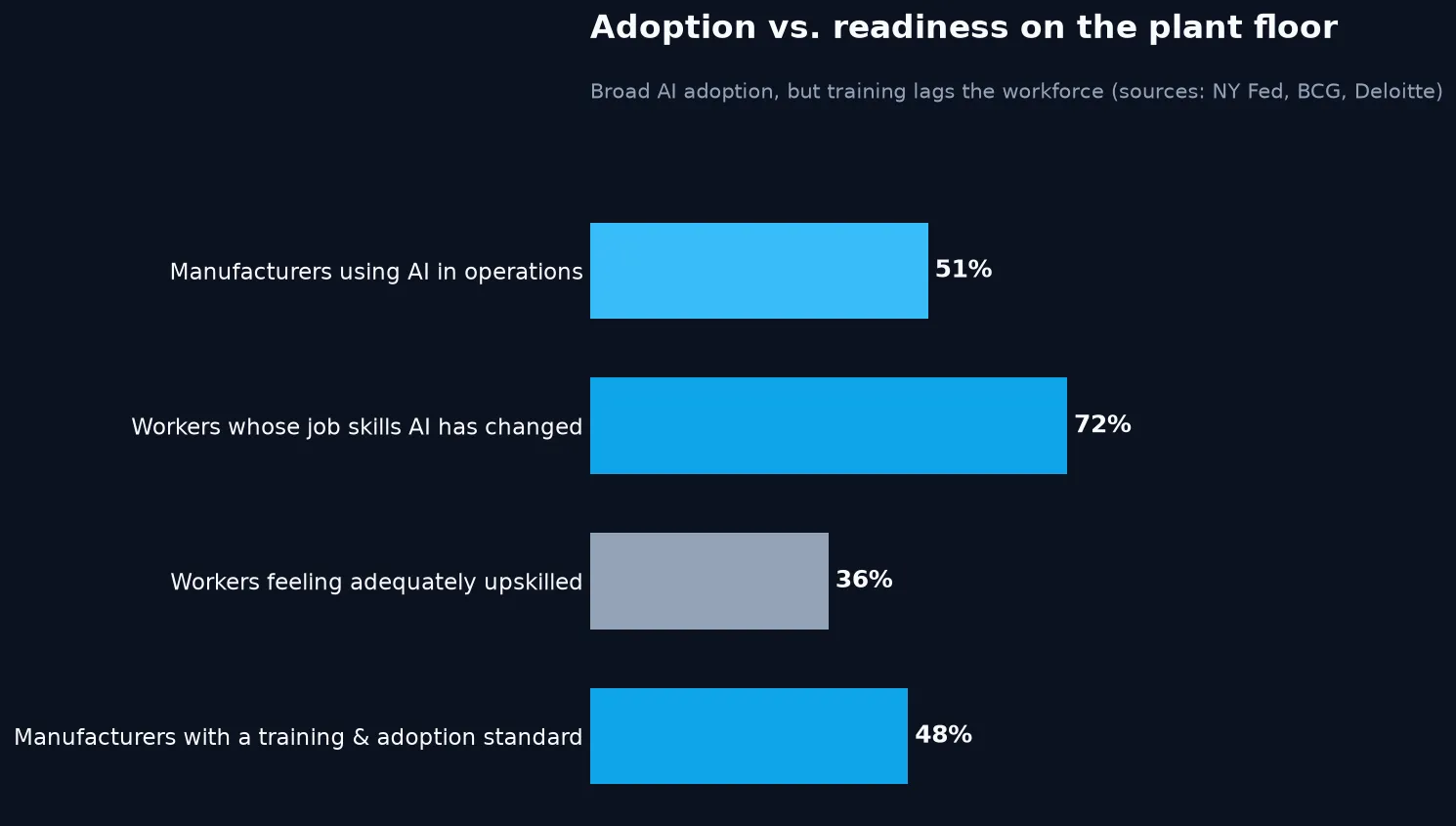
TL;DR: In manufacturing, AI is arriving on the production floor faster than teams are being trained — and the gap is measured. According to the Federal Reserve Bank of New York, 51% of manufacturers now use AI in their operations in 2026, up from 26% in 2025 ([NY Fed, Liberty Street Economics, 09/2026]). Yet according to Boston Consulting Group, 72% of workers say AI has already changed the skills their jobs require, but only 36% feel adequately upskilled ([BCG, AI at Work, 2026]). AI training in industry is therefore not a competitive advantage: it is a condition for operating equipment that is already installed. This article gives you the method to train both production-floor teams and managers — role-based plans, critical skills, on-site deployment and funding. Every figure is sourced.
« Formation ia industrie » is barely typed as such (null volume — [DataForSEO data, collected 18/09/2026]): this article covers the query « formation ia entreprise » (480 searches/month) from the shop-floor side — operators, technicians and production managers, on-site deployment. It locks the field/operators angle of our training cluster: the company-strategy angle (when to train, organization, ROI) is covered in our guide to structuring company-wide AI skills development.
This article is for industrial leaders, production directors and HR/training managers of SMEs and mid-cap manufacturers. It starts from the measured on-the-ground gap — adoption outpacing training — to give you a framework: which audiences to train, which skills are truly critical, how to run on-site deployment, and how to fund the training plan. It complements our guide to structuring company-wide AI skills development, and the one on choosing the right AI training course.
Why AI training in manufacturing differs from general corporate AI training
AI training in manufacturing has three features that set it apart from generic corporate training — and explain the adoption/training gap measured above.
1. Industrial AI reaches operators, not only white-collar staff
Where general "AI training" mostly targets office staff, manufacturing must train line operators, maintenance technicians and quality inspectors. Boston Consulting Group notes that training tends to reach the people who need it least: managers and salaried staff — while frontline operators remain the least trained ([BCG, via The Produce Wire, 06/2026]).
2. The tool has no value without the operator
A predictive-maintenance system that operators do not trust, or a vision-based quality tool the line lead does not understand, ends up as expensive shelfware ([Deloitte, Smart Manufacturing Survey 2025]). In manufacturing, training is not decorative: it determines the return on the equipment itself.
3. A precise regulatory obligation
In Europe, Article 4 of the EU AI Act (Regulation (EU) 2024/1689) requires providers and deployers of AI systems to ensure a sufficient level of AI literacy for their staff, in force since 2 February 2025 ([EUR-Lex, Regulation (EU) 2024/1689]). We cover this framework in detail in our article on AI compliance for industry.
The four audiences to train in a manufacturing company
An AI training plan treats operators differently from managers. Four distinct audiences, four objectives.
| Audience | Role with AI | Training objective | Target skills |
|---|---|---|---|
| Line operators | Use the tool daily | Operate, build trust, flag anomalies | Practical use, interpreting recommendations, tool limits |
| Maintenance technicians | Keep systems running | Configure, diagnose, know when AI fails | Predictive maintenance, agent supervision, verification |
| Production managers & supervisors | Decide on gains, arbitrate | Run use cases, read indicators, remove blockers | KPI reading, use-case selection, change management |
| Executive leadership | Validate the investment | Define strategy, measure ROI, arbitrate compliance | Strategic vision, AI governance, regulatory literacy |
To confirm with Damien : the exact allocation of training time per audience and per role's technical prerequisites depends on your tool, your plant and your company culture. This table gives the segmentation logic, not a headcount of hours to apply as-is.
The skills that are truly critical (and the ones we overestimate)
The skills gap is not always where we think it is. Field surveys give a useful order of magnitude.
What field studies measure
In the 2025 ABBYY survey (opinion across 151 manufacturing organisations), 34% of industrial leaders said their staff struggled to deploy generative AI due to a lack of skill, and only 53% invested in staff training ([ABBYY, GenAI Confessions, 10/2025]).
The Federal Reserve Bank of New York, meanwhile, points to the slowness of retraining: while 51% of manufacturers use AI, barely more than 20% are retraining their workers in response, and the median share of workers actually using the tool is just 7% among manufacturing firms that have adopted it ([NY Fed, Liberty Street Economics, 09/2026]).
The main risk is not technical
Boston Consulting Group stresses that the problem is not the algorithm: only a third of frontline workers say leadership communicates clearly about AI, and only 28% see a strong link between what leaders say about AI and what the organization actually does ([BCG, AI at Work, 2026]). In other words, the first skill to train is trust and communication, before the technical one.
Running on-site AI training — a five-step method
On-site deployment is not about booking modules. Here is a sequence that works with the realities of a factory — shift schedules, operators working rotations, an already-installed tool.
1. Map the roles and their interaction with AI
Before any training purchase, identify the roles that genuinely touch AI: who sees the tool's recommendations daily? Who must verify its output? This mapping is the starting point of any plan — it is the object of our industrial AI audit.
2. Train at the moment of deployment, not in a vacuum
Training disconnected from a concrete project gets lost. The most productive format is the one that prepares a specific deployment — a conclusion our guide on choosing the course elaborates.
3. Mix short formats and practice on the real tool
Short formats (half a day to one day) work better for operators than long academic curricula, and adapt to production constraints. The key is the loop: train → practice on a real case → deploy → measure → adjust.
4. Designate on-the-floor champions
Training transfers better when the person teaching is a respected peer, not only an external consultant. Train operators as AI champions first, then let them coach colleagues — this accelerates adoption ([Deloitte, via The Produce Wire, 06/2026]).
5. Measure ROI on your indicators, not on promises
The return is calculated on your processes: inspection time reduced, unplanned stoppage avoided, document volume processed, compliance lead time. McKinsey documents that leaders who receive the support and training they need are 3.3 times more likely to report enterprise value capture (30% versus 9%) ([McKinsey, "From adoption to impact"]). Method: measure the baseline before training, measure after deployment, then calculate gain × frequency − cost.
Funding the training plan: the European view
Across Europe, employee training funding flows through a mix of public and pooled schemes. In the European Union, the AI Act's AI-literacy requirement gives the regulatory rationale for budgeting training as a recurring operating cost rather than a one-off purchase.
In France — one reference example of a pooled-funding model — employee training passes mainly through the Opérateurs de compétences (OPCOs), which manage the company training plan for companies with fewer than 50 employees. France compétences confirms that in 2024, 4.554 million training actions were initiated by companies, at an average unit cost of €568, with the average remaining charge to the company at 38% — rising to 67% for companies with more than 50 employees ([France compétences, Report on the use of funds 2025]).
To confirm with Damien : the precise eligibility of an AI training for a pooled-funding scheme (whether OPCO in France or an equivalent European or national body in your country) depends on the sector, company size, available funds and the provider's quality certification. France compétences notes that "the effects of public and pooled funding remain poorly known". No specific "AI training" funding rate could be verified on an official source — confirm with the relevant body before committing.
FAQ
What is the difference between AI training for industry and AI training for a company? This article locks the shop-floor angle: line operators, technicians and production managers, on-site deployment — where the company training covered in our guide to structuring company-wide AI skills development addresses mostly office staff (when to train, organization, ROI). In manufacturing, training directly determines the return on the AI equipment already installed, and adjusts to production constraints (shift teams, an already-installed tool).
Who should be trained first in a plant? The people who touch the tool daily: line operators and maintenance technicians. But management and supervision must be trained in parallel to remove blockers and read indicators — otherwise technical training stalls for lack of decisions. BCG shows that training and communication tend to reach managers better than operators; this is the imbalance to correct ([BCG, 2026]).
Is AI training mandatory in industry? Yes, in part: Article 4 of the EU AI Act (Regulation (EU) 2024/1689) requires providers and deployers of AI systems to ensure a sufficient level of AI literacy for their staff, in force since 2 February 2025 ([EUR-Lex]). This obligation concerns all AI systems, regardless of risk level.
How do I fund AI training for my manufacturing company? Mainly via pooled and public training schemes. In France, the OPCOs fund the company training plan — 4.554 million training actions in 2024 at an average cost of €568. Eligibility depends on the sector, company size and the provider's quality certification — confirm with the relevant body.
How do I measure the return on investment of AI training in manufacturing? By defining a measurable objective before training (inspection time, stoppages avoided, volume processed, compliance lead time), measuring the baseline, then the state after deployment, and calculating gain × frequency − cost. Targeted training makes leaders 3.3 times more likely to report enterprise value capture ([McKinsey]).
Conclusion: train the floor, not just the boardroom
In manufacturing, AI training suffers from a measurable lag: adoption (51% of manufacturers) far outpaces training (only 53% invest, and only 36% of workers feel trained). The challenge is not multiplying modules — it is training, at the right moment and on the real tool, the operators, technicians and managers whose actions determine the return on the equipment already in place.
Those who train the floor — not just the boardroom — at the moment of deployment will, in eighteen months, have teams that use AI daily and indicators that prove it. Those who wait will have installed a tool no one uses.
👉 Contact us — Let us identify which roles in your plant touch AI, and build a training plan for your production teams and managers, anchored on your use cases and your funding.
Article published 7 September 2026. Data: Federal Reserve Bank of New York (Liberty Street Economics, 09/2026), Boston Consulting Group (AI at Work, 2026), Deloitte (Smart Manufacturing Survey 2025), ABBYY (GenAI Confessions, 2025), McKinsey & Company, France compétences (Report on the use of funds 2025), EUR-Lex (AI Act, Regulation (EU) 2024/1689). Every figure is sourced inline.