
Generative AI for Business: Use Cases, Governance and Measured ROI in Manufacturing
Generative AI for business: industrial use cases, data governance and security, workforce training, sourced measured gains. A deployment guide for manufacturing SMEs and mid-caps.
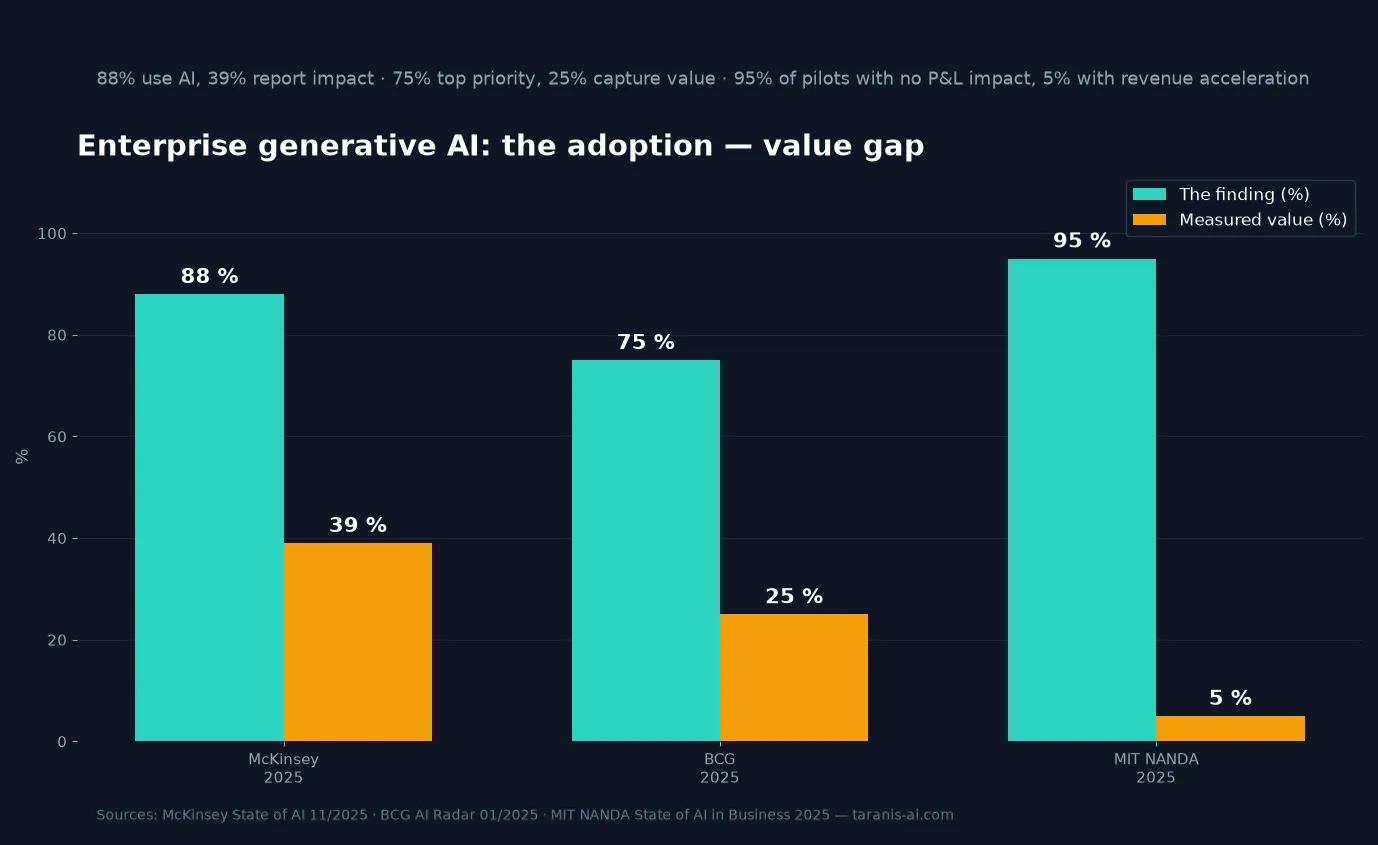
TL;DR: Generative AI entered the enterprise faster than the value it produces. According to McKinsey, 88% of organisations use AI in at least one function in 2025, up from 78% a year earlier — but only 39% attribute any operating-profit impact to it, most often below 5% ([McKinsey, State of AI, 11/2025]). Boston Consulting Group measures the same gap: 75% of executives rank AI among their top three strategic priorities, yet only one quarter report meaningful value ([BCG, AI Radar, 01/2025]). And MIT's NANDA initiative finds that only about 5% of generative AI pilots achieve rapid revenue acceleration ([MIT NANDA via Fortune, 08/2025]). This article gives you the method for moving from pilot to result: industrial use cases that pay off, data governance and security, workforce training, and measured gains. Every figure is sourced.
"Generative AI" triggers a Google AI Overview: it is the question executives type when they move past the pilot stage and look for how to deploy. The pages that rank for it describe tools; none gives manufacturers a complete deployment framework — use cases, governance, training, measurement. That is what this article does.
It is written for executives, plant managers and CIOs at manufacturing SMEs and mid-caps. It complements our guide to AI use cases that pay off on the shop floor, our method for training production teams and managers, our AI compliance guide for industry and our AI in manufacturing landscape.
Generative AI is everywhere — value much less so
Three independent surveys document the same finding: adoption is soaring, value lags far behind.
McKinsey has tracked the curve since 2017. In March 2025, 71% of respondents said their organisations regularly used generative AI in at least one function, up from 65% in early 2024 ([McKinsey, State of AI, 03/2025]). By November 2025, 88% reported using AI in at least one function, versus 78% a year earlier — but only 39% attributed any level of EBIT impact to AI, most of them less than 5% of EBIT ([McKinsey, State of AI, 11/2025]).
BCG, which surveyed 1,803 executives across 19 markets, frames the gap differently: 75% of executives rank AI among their top three strategic priorities, but only one quarter report meaningful value — and 60% of companies define and track no financial KPI at all for AI value creation ([BCG, AI Radar, 01/2025]). You cannot manage what you do not measure.
MIT provides the starkest data point: in the NANDA State of AI in Business 2025 study (150 executive interviews, 350 employees surveyed, 300 public deployments analysed), about 5% of AI pilots achieve rapid revenue acceleration — the vast majority stall, delivering little to no measurable P&L impact ([MIT NANDA via Fortune, 08/2025]). And the prize is not where budgets go: more than half of generative AI budgets fund sales and marketing tools, while MIT finds the greatest ROI in back-office automation — eliminated outsourcing, reduced agency costs, streamlined operations.
This gap is not a technical fate. MIT attributes it to the "learning gap" — the learning deficit of tools and organisations — not to model quality. In other words: the problem is not AI, it is deployment. The next three sections describe how to get it right.
The use cases that pay off in a manufacturing business
McKinsey observes that organisations most often use generative AI in marketing and sales, product and service development, service operations and software engineering ([McKinsey, State of AI, 03/2025]). Transposed to plant and engineering realities, that yields five families of use cases — ranked by proximity to measurable value.
| Use case | Manufacturing application | Why it pays off |
|---|---|---|
| Augmented technical documentation (RAG) | Querying machine manuals, routings, quality procedures and lessons learned in natural language | Cuts technicians' information-search time; preserves knowledge that walks out the door with retirements |
| Repetitive document processing | Inspection reports, non-conformance reports, tender responses, compliance files | This is the "back office" where MIT measures the highest ROI: high volumes, standardised processes |
| Technical support and customer service | An assistant that pre-qualifies service requests, suggests diagnostics and drafts repair routings | Gartner predicts that by 2029, agentic AI will autonomously resolve 80% of common customer service issues, cutting operational costs by 30% ([Gartner, 03/2025]) |
| Engineering and code | Generating and reviewing code (PLCs, supervision, business applications), automatic documentation | Measured gains on engineering and industrial-IT team cycles |
| Training and knowledge transfer | An AI tutor grounded in your internal documentation to train operators and technicians | Accelerates upskilling without permanently tying up experts — see our industry AI training guide |
Two selection rules, drawn from the surveys. First, depth over breadth: leading companies focus on 3.5 use cases on average versus 6.1 for the rest, and expect 2.1 times more ROI ([BCG, AI Radar, 01/2025]). Second, start with the measurable back office, not the showcase: a "tender response" pilot with a metric (hours per bid) will always beat an "innovative chatbot" pilot with none. Our analysis of AI use cases on the shop floor details this prioritisation logic for production.
Illustrative scenario (non-binding figures): a 400-employee mid-cap deploys a documentation assistant grounded in its routings and manuals. The gain is measured in search hours saved per technician per week, multiplied by the loaded hourly cost — measured before, measured after. It is that measurement discipline, not the tool, that separates the 5% that succeed from the rest.
Governance and data security: the framework that already applies
Deploying generative AI in a business means connecting a system that reads, memorises and generates from your data. Three frameworks already apply — a European regulatory one, a data-protection doctrine, and a technical security baseline.
1. The EU AI Act applies — including to users. Since 2 February 2025, Article 4 of Regulation (EU) 2024/1689 requires both providers and deployers of AI systems to ensure AI literacy among their staff ([EUR-Lex, Regulation (EU) 2024/1689]). Since 2 August 2025, obligations for providers of general-purpose AI models (technical documentation, copyright policy, public training-data summary) apply — with enforcement and fines from 2 August 2026 ([European Commission, GPAI obligations]). If you buy a system built on a general-purpose model, demand your supplier's documentation: your own downstream compliance depends on it. We detail this framework in our AI compliance guide for industry.
2. Data-protection authorities have set the doctrine. France's CNIL confirmed in its July 2025 guidance that the GDPR does not block AI but imposes its discipline: training-data minimisation, informing individuals, effective rights of access, rectification, objection and erasure, and privacy by design — with particular attention to personal data in training sets ([CNIL, AI & GDPR guidance, 22/07/2025]). In practice: never let an employee paste customer data, drawings or formulas into a public service without an enterprise contract — what you send there may train a third-party model.
3. Security agencies describe real attacks. The security guide for generative AI systems lists the impacts to address: reputational damage through system manipulation, sensitive-data exfiltration, theft of proprietary model weights, lateral movement into connected business applications (internal messaging, ERP), and sabotage via vulnerabilities injected into AI-generated source code ([ANSSI via cyber.gouv.fr, Security recommendations for generative AI systems]).
In practice, minimum governance comes down to five decisions: a designated AI owner (McKinsey notes 28% of AI-using organisations place AI governance oversight with their CEO); a usage charter (what may and may not be sent to the tools); systematic human validation of generated content before external use — only 27% of users report employees reviewing all AI-generated content before use ([McKinsey, State of AI, 03/2025]); data segregation (authorised-scope RAG, dedicated instances for sensitive data); and usage logging for audit and rights requests.
Training the workforce: without them, the tool produces nothing
This is the factor every survey ranks first — and the most neglected. BCG sums up the leaders' recipe as the 10-20-70 principle: 10% of effort on algorithms, 20% on data and technology, 70% on people, processes and culture ([BCG, AI Radar, 01/2025]).
Yet the AI at Work 2025 survey (over 10,600 workers, 11 countries) shows how far behind organisations are: regular use among frontline employees has stalled at 51%, while more than three quarters of managers use generative AI several times a week; only one third of employees say they have been properly trained; and regular usage jumps among those receiving at least five hours of training with in-person coaching ([BCG, AI at Work 2025]). Visible leadership support changes everything: the share of employees positive about generative AI rises from 15% to 55% with strong support — which only one quarter of frontline workers say they receive.
Three consequences for a manufacturing business. Train at deployment time, on the real tool, not six months earlier in a classroom. Train operators as much as managers — the current bias favours those who need it least. And appoint shop-floor relays to coach their peers, because trust in the tool spreads horizontally. Our industry AI training guide gives the full method — audiences, critical skills, on-site rollout sequence.
What it earns: measure instead of believing
The surveys' final lesson is the simplest: companies that measure earn more. Organisations that redesign their workflows track created value better — time saved per day, output quality, improved decisions — and that measurement justifies scaling ([BCG, AI at Work 2025]).
The method takes four steps: define a financial metric before the pilot (hours per file, cost per support ticket, tender-response lead time); measure the baseline over four to six weeks; deploy on a restricted scope with human validation; compare, then decide to scale or stop. BCG notes leaders expect 2.1 times more ROI precisely because they concentrate on few use cases, transform processes in depth and systematically measure financial and operational returns ([BCG, AI Radar, 01/2025]).
To confirm with Damien: orders of magnitude observed on Taranis-supported deployments (hours saved per process, compliance lead times) — Taranis publishes no client figures without real measurement on real data.
FAQ
What is generative AI in business? Generative AI in business means applying models capable of creating content (text, code, images, summaries) to organisational processes: technical documentation, tender responses, customer support, engineering, training. In 2025, 88% of organisations report using AI in at least one function ([McKinsey, 11/2025]) — but only 39% measure a financial impact.
Why do most generative AI projects fail? According to MIT (NANDA initiative, 2025), only about 5% of pilots achieve rapid revenue acceleration; the vast majority stall with no measurable impact. The root cause is not model quality but organisations' learning gap: vague goals, poor workflow integration, insufficient training ([MIT NANDA via Fortune, 08/2025]).
Which use cases are most profitable in manufacturing? Augmented technical documentation (RAG over manuals and routings), repetitive document processing (inspections, non-conformances, tenders), technical support and software engineering. MIT measures the highest ROI in back-office automation, not in the sales and marketing tools that capture most budgets.
What are the legal obligations for deploying generative AI in a business? In the EU: mandatory staff AI literacy since 2 February 2025 (AI Act Article 4); general-purpose model provider obligations applicable since 2 August 2025, fines from 2 August 2026 ([European Commission]). Data-protection rules (GDPR) apply wherever personal data is involved: minimisation, transparency, rights, security.
How do you secure data against generative AI risks? Never send sensitive data to a public service without an enterprise contract; segregate scopes (authorised RAG, dedicated instances); validate all content with humans before external use; log usage. Treat the documented risks: data exfiltration, model theft, lateral movement into business applications, vulnerabilities injected into generated code ([ANSSI]).
How do you measure generative AI ROI? Define a financial metric before the pilot, measure the baseline, deploy on a restricted scope with human validation, compare. Leading companies focus on 3.5 use cases on average (versus 6.1) and expect 2.1 times more ROI ([BCG, AI Radar, 01/2025]). Without a defined metric — like 60% of companies — there is no demonstrable ROI.
Conclusion: three use cases, one governance framework, one metric
Generative AI in business does not fail because the technology is immature — it fails when deployed without focused use cases, without data governance and without measurement. Successful organisations do the opposite: few use cases, chosen in the measurable back office; governance that applies the AI Act, data-protection doctrine and security baselines; large-scale frontline training; a financial metric tracked from day one.
Eighteen months from now, the gap will have widened between companies that transformed their processes and those that stacked up pilots. The former will have metrics to prove it.
👉 Contact us — Let us identify together your three highest measurable-return generative AI use cases, and build the governance, security and training framework that will take them into production.
Article published 14 September 2026. Data: McKinsey (State of AI, 03/2025 and 11/2025), Boston Consulting Group (AI Radar, 01/2025; AI at Work, 2025), MIT NANDA (State of AI in Business 2025, via Fortune 08/2025), Gartner (03/2025), European Commission (GPAI obligations), CNIL (AI & GDPR guidance, 22/07/2025), ANSSI (generative AI system security), EUR-Lex (AI Act, Regulation (EU) 2024/1689). All figures are sourced inline.