
AI in Manufacturing 2026: Adoption, Applications, and Deployment Roadmap for French Industry
AI in manufacturing: France adoption data, use cases by domain (predictive maintenance, quality control, cobots, supply chain), verified ROI figures, regulatory framework, and deployment roadmap for industrial SMEs and mid-caps.
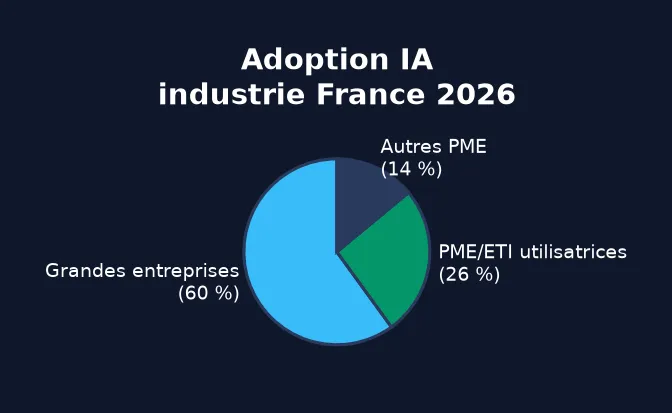
TL;DR : AI in French manufacturing has moved past the promise phase and entered industrialization. According to KPMG, 60% of large organizations have deployed cross-functional AI governance by 2026, and two-thirds now measure AI ROI. Among SMEs, Bpifrance reports that 26% already use generative AI, and another 28% plan to. Industrial applications cluster around four areas: predictive maintenance (30–45% fewer unplanned stoppages), vision-based quality control, cobotics, and supply chain optimization. The regulatory framework is taking shape with the AI Act (transparency obligations as of August 2, 2026), the EU industrial data regulation, and ISO 42001. This article gives you the data-based landscape, use cases per function, and a deployment roadmap.
70 monthly searches in France for "intelligence artificielle industrie" (AI in manufacturing), plus roughly 100 more for related variants "ia industrielle" and "ia pour l'industrie" ([DataForSEO data, collected Aug 30, 2026]). The topic is growing, yet most Google results remain vendor pages — IBM, Alten, KPMG — that describe their solutions without answering the question industrial decision-makers actually ask: where do I start?
This article does the opposite. It gathers the adoption data for France, details industrial use cases per domain with sourced figures, and gives you a phased roadmap — whether you lead a 50-person SME or a 500-person mid-cap. For the back-office side — technical documentation, tender responses, support — see our generative AI in business guide.
All figures are from verified sources: KPMG, Bpifrance, the French Senate, the European Investment Bank, and the European Commission.
The State of Play: Where French Industry Stands
Two-speed adoption
Multiple studies paint a consistent picture. Among large companies, the trend is clear: 60% of organizations have deployed cross-functional AI governance to industrialize AI, according to the second edition of KPMG's Trends of AI 2026 study, based on 356 French decision-makers (62% executive committee members) ([KPMG, Trends of AI 2026]). Governance has also progressed: 86% of companies have validated a responsible AI charter, typically driven by the executive committee.
SMEs and mid-caps lag behind but are moving. Bpifrance Le Lab's survey (AI in French SMEs and Mid-Caps) finds that 26% of companies with 10–5,000 employees already use generative AI, while 28% more plan to — over half of all SMEs are concerned in the near term ([Bpifrance Le Lab, via independant.io]). The European comparison remains unfavorable: only 24% of French companies used generative AI in 2025, versus a European average of 37%, according to the EIB Investment Survey ([EIB, EIBIS 2025]).
The market and ecosystem
The French Senate's report Enterprise 5.0 (April 2026) provides a comprehensive picture: over 1,000 active AI startups in 2025 (Hub France IA), 4,000 researchers in the field, and an overall market estimated at €20 billion by 2030 ([French Senate, report n°572, 04/28/2026]). The report also notes that 76% of French people have received no AI training (University of Melbourne) — a direct signal for companies that will make training a competitive lever. For more on AI training options, see our dedicated article: [AI Training for Business].
ROI measurement is improving
A key maturity signal: two-thirds of organizations can now measure the ROI of their AI projects, compared to only one-third in 2025 (KPMG Trends of AI 2026). In manufacturing specifically, AI deployment is progressing faster than elsewhere in the European Union ([EIB, EIBIS 2025]).
Industrial AI: Four Application Domains
1. Predictive maintenance: from reaction to anticipation
This is the flagship application. IoT sensors analyzed by machine learning algorithms predict failures before they occur. Documented returns include:
| Metric | Improvement | Source |
|---|---|---|
| Unplanned stoppages | –30 to 45% | McKinsey Global Institute, IoT 2015 |
| Maintenance costs | –25 to 30% | Field data, Deloitte Smart Factory studies |
| Production output | +10 to 20% | Deloitte 2026 Smart Manufacturing Study |
Automotive manufacturers, for instance, use predictive maintenance on assembly-line robots to cut unplanned downtime significantly. Detailed deployment — sensors, models, ROI — is covered in our predictive maintenance guide.
2. Vision-based quality control
Computer vision replaces human inspection on production lines for repetitive quality checks. The impact is documented: a meta-analysis by Garza et al. (2023) across 37 industrial studies reports a reduction in error rates from 6.57% to 0.14% (a 98% decrease) in AI-assisted data-entry tasks ([Garza et al., 2023]).
Vision systems analyze product images in real time, flagging defects with greater accuracy than human inspectors — especially in electronics and automotive manufacturing.
3. Cobots and collaborative robots
Collaborative robots (cobots) work alongside human operators. AI allows them to adapt to production environment variations without reprogramming. Cobots handle repetitive or physically demanding tasks while operators focus on higher-value work.
4. Supply chain optimization
AI-powered supply chain management enables scenario modeling, shortage anticipation, and flow optimization. According to KPMG's Trends of AI 2026 study, supply chain is one of eight key functions where AI is being deployed in French companies, with rapid productivity gains ([KPMG, Trends of AI 2026]). Generative AI is used for document content generation, scenario modeling, and advanced automation in supply chain management.
Regulatory Framework: What Changes in 2026
AI Act: first operational obligations
The EU AI Act has been gradually entering into force. Since August 2, 2026, transparency obligations (Article 50) apply to AI systems — including those in manufacturing. Concretely, a computer-vision system that classifies parts as "pass" or "defect" must be able to explain its decisions. High-risk systems (especially those used in product safety, by 2027–2028) will face enhanced requirements ([EUR-Lex, AI Act]). For a full regulatory analysis, see our article: [AI Act Compliance: What Changes in 2026].
ISO 42001: the AI management standard
ISO 42001, published in 2023 and now adopted in France, provides a management framework for AI systems. It covers governance, risk management, impact assessment, and documentation. It is the recommended framework to structure your AI approach, alongside the AI Act.
CSRD and indirect impact
By optimizing production processes, AI indirectly contributes to CSRD non-financial reporting objectives. McKinsey documents that cloud-based CSRD reporting solutions are 80% cheaper and 3 times faster than manual approaches ([McKinsey, Cloud-powered technologies for sustainability, Nov 2023]).
Deployment Roadmap: Three Phases
Phase 1: Diagnose (months 1–2)
Before any technology purchase, take stock:
- What data do you already produce? (sensors, ERP, MES, CRM)
- Which processes are candidates? (repetitive, manual, high-variability)
- What AI skills do you have in-house?
Bpifrance offers a specific program: the AI & Industry Accelerator (18 months, total cost €71,800 ex. tax, with €25,400 covered by Bpifrance via the Osez l'IA plan) including 12 days of Data AI Industry diagnosis ([Bpifrance, AI & Industry Accelerator]).
Phase 2: Start with a quick-ROI use case (months 3–6)
Choose a first project with high return and low risk: predictive maintenance on one critical machine, or automated quality control on one line. First results should be visible in 3 to 6 months to build confidence and justify the next steps. For a tailored approach, see how we conduct an [industrial AI audit].
Phase 3: Industrialize and govern (months 6–18)
Once the first case is validated:
- Set up AI governance (usage charter, system register, responsibilities)
- Deploy cross-functional governance (KPMG confirms 60% of organizations already do)
- Train your teams: the Senate report notes that 76% of French people have received no AI training ([French Senate, report n°572]) — this is the primary competitiveness lever for companies investing in upskilling
FAQ
Is industrial AI only for large companies? No. Bpifrance Le Lab shows a quarter of French SMEs and mid-caps already use generative AI. Bpifrance offers a dedicated accelerator, and entry costs are falling with SaaS solutions and accessible AI APIs that don't require proprietary infrastructure.
What is the typical ROI for an industrial AI project? ROI varies by domain: 30–45% fewer stoppages (predictive maintenance), 10–20% productivity gain (Deloitte Smart Manufacturing), 98% error reduction on certain data-entry tasks (Garza et al., 2023). ROI is typically visible within 6 to 18 months — two-thirds of organizations now measure it (KPMG).
Does the AI Act apply to industrial AI systems? Yes, transparency obligations have applied since August 2, 2026. High-risk systems (product safety, critical infrastructure) will face enhanced requirements from 2027–2028. Anticipating compliance from the design stage is recommended.
Do I need an in-house data scientist to start? Not necessarily. Many industrial platforms couple AI with SaaS solutions that don't require in-house data science expertise for initial use cases. Skills upgrading (training, recruitment) becomes relevant during the industrialization phase.
What's the first mistake to avoid? Starting with the technology instead of the problem. AI projects that fail rarely do so for technical reasons — the root cause is typically misalignment with business needs, inaccessible data, or absent ROI measurement. Bpifrance recommends a Data AI Industry diagnosis before any investment.
Conclusion: Competitive Advantage Is in Execution, Not Technology
AI in French manufacturing is at a tipping point. The data is available, the ROI is documented, and the regulatory framework is taking shape. The gap is no longer about technology — which is accessible — but about the ability to organize it, govern it, and execute it.
Manufacturers that start their AI journey in 2026 will have a real competitive advantage by 2027–2028: organized data, trained teams, optimized processes. Those who wait will have access to the same technologies — but with an execution gap that will be hard to close.
👉 Contact us — Let's assess your industrial AI maturity, identify your first quick-ROI use cases, and structure your roadmap.
Published August 30, 2026. Search data: DataForSEO, France, collected Aug 30, 2026. Figures from KPMG (Trends of AI 2026), Bpifrance Le Lab, French Senate (Enterprise 5.0, report n°572), EIB (EIBIS 2025), McKinsey (Cloud-powered technologies for sustainability), Garza et al. (2023), Deloitte Smart Manufacturing, and EUR-Lex (AI Act). Regulatory dates verified: AI Act art. 50 = August 2, 2026 (high-risk 2027–2028).