
Predictive Maintenance: AI Use Cases, Sensors, and ROI in Manufacturing
AI-driven predictive maintenance: sensors, models, failure detection, deployment, and sourced ROI. A data-backed guide for industrial SMEs.
TL;DR : AI-driven predictive maintenance is the industrial use case with the best-documented return. AI systems that anticipate failures cut unplanned downtime by up to 70% and extend asset life by 25–30% (OECD). A pilot on a single asset class cut unplanned downtime by 80% with roughly $300,000 in savings per asset (Deloitte). Predictive maintenance reduces planning time by 20–50%, raises equipment uptime and availability by 10–20%, and lowers overall maintenance costs by 5–10% (Deloitte). This article gives you the concrete use cases — sensors, models, failure detection —, the deployment organization, and the ROI logic.
Predictive maintenance is not a definition problem — it is a concrete question industrial operators ask every day: what does it really return, and where do I start?
This article answers that question. It builds on and deepens the panorama of industrial automation and automation by AI agents by focusing on a single use case: predictive maintenance. Sensors, models, failure detection, deployment organization, sourced ROI: everything is quantified and verified. To place this use case in the wider picture — adoption, application domains, roadmap — see the AI in manufacturing landscape.
What is AI-driven predictive maintenance?
Predictive maintenance anticipates the failure before it happens, instead of repairing after the fact (corrective maintenance) or replacing on a fixed schedule (preventive maintenance). AI comes in on the analysis: from the data it receives continuously, a model learns the "signatures" of known failure modes and flags that an asset is drifting — often weeks before the actual failure (McKinsey, "A smarter way to digitize maintenance and reliability," 2022).
The three building blocks: sensors, data, models
| Building block | Role | Example |
|---|---|---|
| Sensors | Measure the asset's real state | Temperature, vibration, pressure, current |
| Data | Historize and contextualize | Failure history, ERP/MES data, work orders |
| Models | Detect drift and predict | Regression, time series, anomaly detection, machine learning |
These three blocks explain the maturity gap: many plants already have the sensors (threshold alarms), fewer have structured data, and only a minority train predictive models. That is exactly where the value pool sits.
Concrete use cases in production
AI-driven predictive maintenance applies wherever a critical asset produces data and its downtime is expensive. Three cases dominate.
Failure detection through vibration analysis
The most widespread case. A compressor, motor, pump, or rotating machine emits a vibration spectrum that shifts as a bearing wears or an imbalance appears. A model trained on history separates normal noise from the failure signature and triggers a planned intervention before the break.
The OECD documents this type of system in its 2025 report on AI and competitiveness: AI-based predictive maintenance systems in manufacturing "anticipate failures ahead of time, and thereby sharply lower unplanned downtime and emergency repair costs," with unplanned downtime reductions of up to 70% and asset lifecycle extension of 25–30% (OECD, "Artificial intelligence and competitive dynamics in downstream markets," 2025).
Condition monitoring: monitor state instead of fixed-interval change
Condition monitoring replaces calendar-based preventive maintenance. Instead of replacing a part every X months "to be safe," you monitor its real state and intervene only when it degrades. This is the most profitable use case for high-cost parts with variable lifespan.
Deloitte summarizes the gains of predictive maintenance in its Industry 4.0 work: it reduces the time required to plan maintenance by 20–50%, increases equipment uptime and availability by 10–20%, and reduces overall maintenance costs by 5–10% (Deloitte Insights, "Industry 4.0 and predictive technologies for asset maintenance," 2017). Deloitte also puts the cost of unplanned downtime for manufacturers at an estimated $50 billion each year (idem).
Predictive models on critical, capacity-constrained assets
For a "capacity-constrained" asset — one whose failure blocks an entire line — predictive maintenance does more than avoid failure: it increases throughput. McKinsey reports that an offshore oil and gas operator, after deploying a predictive system across a fleet of platforms, achieved a 20 percent average reduction in downtime and production increases equivalent to more than 500,000 barrels of oil annually, on a fleet already in the top quartile of sector performance (McKinsey, "A smarter way to digitize maintenance and reliability," 2022).
The ROI of predictive maintenance: what the numbers say
The figures below come from independently verified studies, checked verbatim. They give orders of magnitude — your project's ROI is calculated on your assets, your downtime, your costs.
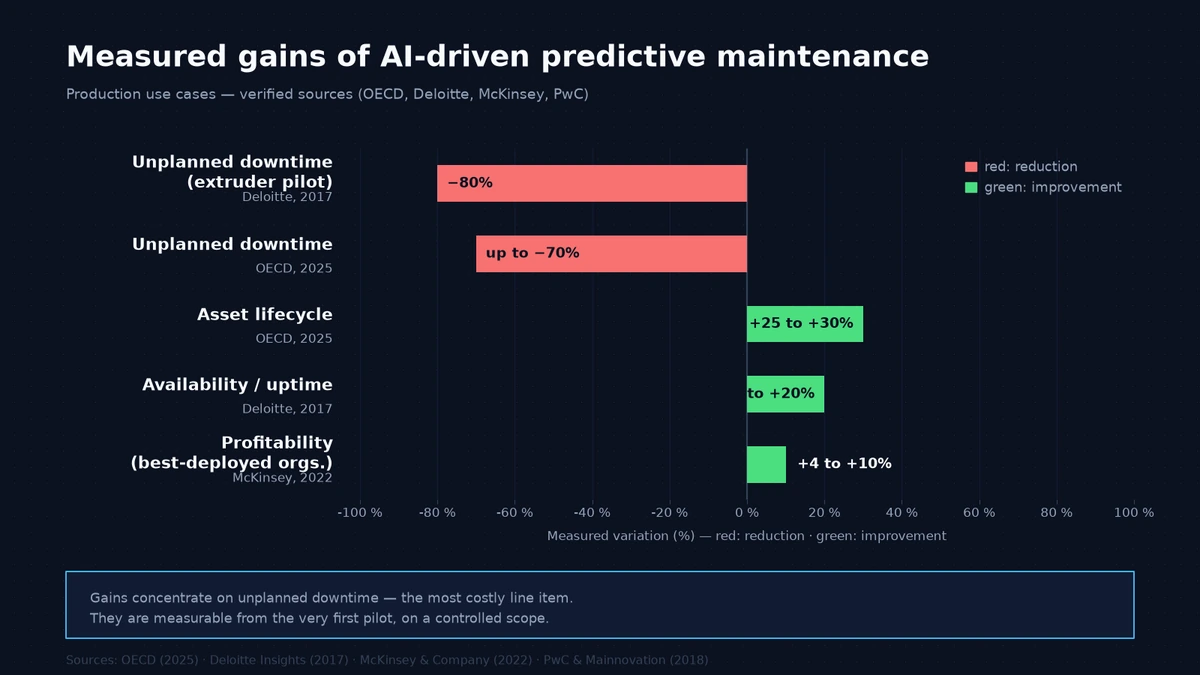
| Metric | Measured gain | Source |
|---|---|---|
| Unplanned downtime | up to −70% | OECD, 2025 |
| Asset lifecycle | +25 to +30% | OECD, 2025 |
| Unplanned downtime (extruder pilot) | −80%, ~$300,000/asset | Deloitte, 2017 |
| Maintenance planning time | −20 to −50% | Deloitte, 2017 |
| Uptime / availability | +10 to +20% | Deloitte, 2017 |
| Overall maintenance costs | −5 to −10% | Deloitte, 2017 |
| Profitability (best-deployed organizations) | +4 to +10% | McKinsey, 2022 |
A complementary data point: in the PwC and Mainnovation survey of 268 companies, 60% of respondents who implemented predictive maintenance saw an improvement in uptime, with an average improvement of no less than 9% (PwC & Mainnovation, "Beyond the hype: PdM 4.0 delivers results," 2018).
Two lessons emerge. First, the gains are concentrated on unplanned downtime — the most costly and most visible line item. Second, they are measurable from the very first pilot — not a theoretical five-year ROI, but gains observed on one asset, one asset class, one controlled scope.
How to organize deployment in your plant
Predictive maintenance is not deployed "in bulk." It is built step by step, each producing a measurable result that justifies the next.
Step 1: Choose the asset that matters
Start with the asset whose failure is most expensive — a compressor, a press, a furnace, an extruder. One critical asset, not a whole workshop. The criterion is not technical complexity but cost of failure.
Step 2: Verify the data
The model is only as good as your data. Verify the asset is instrumented (sensors) and its failure history is usable. If the data does not exist, the first step is to produce it — instrumenting is often a project in itself. McKinsey is explicit: the foundational data (structured equipment, spare parts, work orders) lives in your ERP and serves as the base for the project (McKinsey, "A smarter way to digitize maintenance and reliability," 2022).
Step 3: Start on a fast-ROI pilot
Choose a narrow first scope: one asset, one dominant failure class, one model. McKinsey's method is explicit: develop and refine the approach on one platform before rolling it out to the fleet — then measure, correct, extend (McKinsey, 2022). First results should be visible within months to build trust with the maintenance teams.
Step 4: Measure, then extend
Each pilot serves as a reference: real cost, measured gains (avoided downtime, parts not replaced, planning hours saved), observed return. On that basis you decide to extend to other assets, then to processes.
Step 5: Govern and industrialize
The most overlooked point: predictive maintenance succeeds or fails on the human factor. McKinsey says it plainly: successful implementations "take a holistic view of these new tools, building digital technologies into a clearly defined vision" and "support their use of digital tools by ensuring the necessary enablers are in place — optimized workflows, a robust data infrastructure, and the capabilities of their personnel" (McKinsey, 2022). Without the buy-in of the technicians who respond to alerts, the most accurate model is worthless.
Predictive vs preventive vs corrective maintenance: the right decision framework
| Strategy | When | Limitation |
|---|---|---|
| Corrective ("repair after failure") | Low-criticality asset, low failure cost | Unplanned downtime, lost parts and production |
| Preventive (fixed interval) | Part with reliable, constant lifespan | Replaces still-good parts, does not eliminate variance |
| AI predictive | Critical, instrumented asset with high failure cost | Requires usable data and an organization that reacts |
The key is the cost of failure. The more expensive the downtime — in lost production, reputation, or safety — the more the predictive investment pays off. Conversely, instrumenting a low-criticality asset with sensors and models often makes no economic sense.
FAQ
What is AI-driven predictive maintenance? It is a strategy that anticipates failure before it happens. From sensor data (vibration, temperature, pressure), an AI model learns the signatures of known failure modes and flags that an asset is drifting, enabling a planned intervention instead of repairing after the fact.
What is the difference between predictive and preventive maintenance? Preventive maintenance intervenes on a fixed schedule (replace a part every X months "to be safe"), regardless of real state. Predictive maintenance monitors the asset's state continuously and intervenes only when it degrades — avoiding replacement of still-good parts and anticipating real failures.
What ROI can be expected from predictive maintenance in manufacturing? Studies document up to −70% unplanned downtime and +25–30% asset life extension (OECD 2025), −80% on an extruder pilot with ~$300,000 savings per asset (Deloitte 2017), and +4–10% profitability for the best-deployed organizations (McKinsey 2022). ROI is measurable from the first pilot.
Where do I start with predictive maintenance? Choose the asset whose failure is most expensive, verify the data exists (sensors + failure history), then start on a narrow, fast-ROI pilot: one asset, one failure class, one model. Measure, then extend.
Which sensors and data are needed for predictive maintenance? Three building blocks: sensors that measure real state (temperature, vibration, pressure, current), historized data (failure history, ERP/MES data, work orders), and models trained to detect drift. If the asset is not instrumented, starting by instrumenting it is a step in itself.
Conclusion: predictive maintenance is judged on avoided downtime
AI-driven predictive maintenance is the industrial use case with the best-documented return. The numbers are clear: up to −70% unplanned downtime and +25–30% asset life (OECD 2025), −80% on a pilot and $300,000 savings per asset (Deloitte 2017). What separates the plants that succeed is not the technology — accessible — but the method: choose the right asset, verify the data, start small, measure, extend, and bring the teams on board.
Those who start today on a narrow scope will have in eighteen months a data history and a documented return on investment. Those who wait will pay the same cost — without the history.
👉 Contact us — Let's identify the critical asset where a first predictive maintenance project returns fastest in your production.
Article published September 07, 2026. Figures from the OECD (2025), Deloitte Insights (2017), McKinsey & Company (2022) and PwC & Mainnovation (2018), verified verbatim in the sources.