
← Expertise / Regulatory Compliance
Regulatory Compliance
Regulatory compliance automated with AI: Taranis AI deploys AI agents to turn your European obligations — CSRD, AI Act, PPWR, battery passport — into industrial performance assets. A factual and certifiable approach.
By Damien Godard, founder of Taranis AI · August 14, 2026
The problem: regulatory compliance is exploding
Regulatory compliance has never been heavier for European industry. Each regulation adds data points to collect, evidence to retain and reports to produce — under the scrutiny of increasingly demanding auditors and authorities.
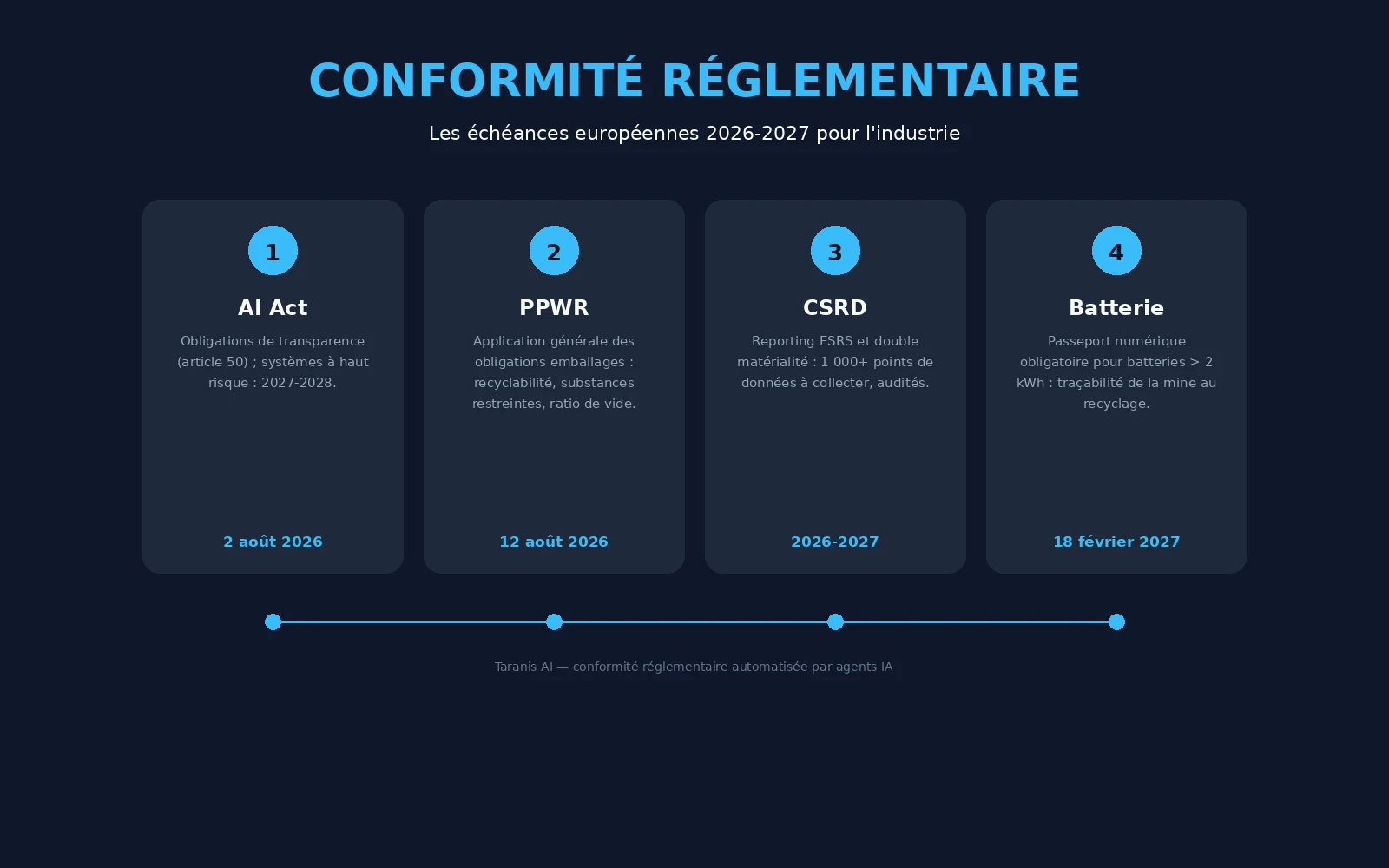
CSRD compliance requires collecting, verifying and auditing more than 1,000 ESRS data points. EU AI Act compliance brings transparency obligations from August 2, 2026, and high-risk system requirements in 2027-2028. The PPWR regulation applies in full from August 12, 2026. The battery passport becomes mandatory on February 18, 2027. Deadlines pile up — compliance teams, however, do not grow.
The result is measurable: months of manual collection, documentation errors, and non-compliance risks that block market access. This is the problem AI agent automation solves.
CSRD Compliance & Double Materiality
Automated ESG data governance (ESRS)
The CSRD directive imposes a reporting rigor matching financial accounting: hundreds of ESRS data points to collect, verify and audit (the July 2026 revised standard keeps about 320 mandatory ones). Our AI agents automate multi-source data collection, while securing your double materiality analysis for auditors.
Automation of ESRS data flows
Secured Double Materiality analysis
Digital Audit Trail for statutory auditors
Automated administrative data collection

Real-Time Carbon Audit (CBAM)
Dynamic carbon traceability at SKU level
Move from an annual estimated carbon footprint to real-time management. Our AI agents calculate the actual carbon footprint at every production step, facilitating CBAM (Carbon Border Adjustment Mechanism) compliance and valuing your low-carbon products in the market.
Dynamic carbon traceability (SKU-level tracking)
CBAM carbon tax anticipation and calculation
Predictive supply chain impact simulation
Certifiable real emissions data

Digital Battery Passport (UID)
Compliance with EU Battery Regulation 2023/1542
We deploy the digital identity infrastructure essential for European market access. The Taranis AI battery passport guarantees traceability of critical raw materials (Lithium, Cobalt) and immutable data integrity from mine to recycling.
Immutable digital identity per battery (UID)
Upstream traceability of strategic raw materials
Compliance reporting for EU Regulation 2023/1542
Secure interfacing with recycling centers

Health Score & Remaining Useful Life (RUL)
Residual value optimization and Second Life
Taranis AI agentic intelligence analyzes real-world usage to accurately calculate SOH (State of Health) and RUL (Remaining Useful Life). This expertise maximizes your asset profitability and certifies battery value for the second-life market.
Predictive remaining useful life calculation (RUL)
SOH certification for Second Life resale
Predictive maintenance driven by AI agents
Unsupervised AI for electrochemical drift detection

PPWR Compliance & Circular Economy
Packaging life cycle management (Regulation (EU) 2025/40)
The European PPWR regulation imposes drastic recyclability and reuse quotas. Our AI agents audit your technical specifications to guarantee packaging compliance, while optimizing void ratio and minimizing the impact of plastic taxes.
Automatic packaging specification audit
Void ratio optimization (legal threshold 40%)
Recycled content rate tracking by SKU
Regulatory compliance certification 2026-2030

Download our PPWR guide
Prepare your company for the PPWR deadline in August 2026.
Guide PPWR
Conformité Pack & Emballages
How AI automates regulatory compliance
Three building blocks, one chain: collect at the source, verify against regulation, document for the audit.
Multi-source collection
AI agents extract your data directly from ERPs, MES, supplier catalogs and technical documents. No more manual data entry or contradictory spreadsheets.
Regulatory verification
Each data point is cross-checked against current requirements: ESRS standards for CSRD, risk classification for the AI Act, restricted substances and recyclability for PPWR, traceability for the battery passport.
Reporting & audit trail
Regulatory reports are generated automatically, with a complete timestamped history of every decision. Your auditors find the evidence in a few clicks — not in several weeks.
Regulatory calendar 2026-2027
Deadlines and estimated effort vary with company size. Plan ahead now.
| Company size | Regulations concerned | Priority deadline | Estimated effort |
|---|---|---|---|
| Very small (<10 emp.) | PPWR (if packaging) | August 2026 | 2-3 weeks |
| SME (10-250 emp.) | CSRD + PPWR + AI Act | 2026-2027 | 3-6 months |
| Mid-size (250-5000 emp.) | CSRD + AI Act + PPWR + Battery | 2026 | 6-12 months |
| Large group | All + consolidated reporting | 2026 | 12-18 months |
The Taranis AI approach
Unlike generic solutions, our approach combines on-site audit and automation. We start with a diagnosis of your current compliance status, then deploy automation workflows where the impact is greatest — with gains measured on your actual data within the first months.