Online AI Training: Choosing a Course Your Teams Will Finish
Online AI training: MOOC, CPF-funded e-learning, virtual classroom or remote in-company? Selection criteria, the pitfalls of 100% remote learning, and a method for industrial teams.
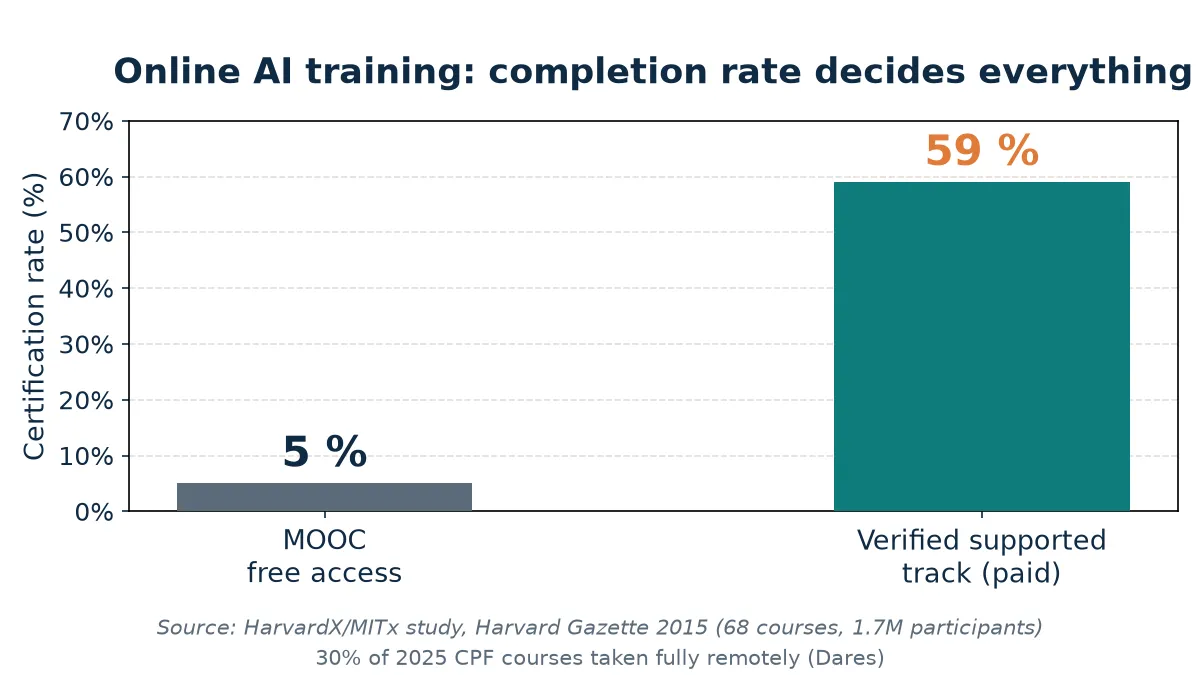
TL;DR: Choosing an online AI course for your teams is not picking a catalogue — it is choosing a programme your employees will finish and apply. The evidence is measured: MOOC certification rates sit around 5% for free access, versus 59% for paid verified tracks ([Harvard Gazette, HarvardX/MITx study 2015]). In France, three out of ten CPF-funded courses are taken fully remotely ([Dares via Cap Métiers, 2025]). This article gives you the method: four "online" formats, five remote-specific criteria, three pitfalls of 100% remote learning, and how to connect online learning with on-the-ground support. Every figure is sourced.
"Formation ia en ligne" (online AI training) represents 320 searches/month in France ([DataForSEO data, collected 09/2026]) — and the pages that rank (online course providers, public MOOCs, aggregators) are catalogues, not decision guides. Yet what companies actually look for, visible in queries such as "formation ia pour équipes" (AI training for teams), is not "where to find a course": it is how to choose an online programme that working employees will complete, and that will lead to real usage. That is the question this article answers.
It is written for executives, HR managers and training managers in industrial SMEs and mid-cap companies. It complements our general guide to choosing an AI training course by dealing exclusively with the online case.
Four "online" formats: do not confuse them
Behind the single label "online" hide four very different arrangements — in cost, in support, and in likelihood of completion.
| Format | Principle | Strengths | Limits | Best for |
|---|---|---|---|---|
| Free MOOC (e.g. public AI initiation MOOCs) | Videos + quizzes, open enrolment, no tutoring | Zero cost, immediate access, mass awareness | Very low completion, no practice on your tools, no individual tracking | Prerequisites, acculturation, testing motivation |
| Tutored certifying e-learning | Structured path with mentor, marked assignments, target certification | Real support, fundable certification (CPF), progress tracking | Higher cost, constrained pace, standard content | Targeted individual upskilling |
| Virtual classroom | Live remote sessions, synchronous group | Interaction with the trainer, no travel, group dynamic | Fixed schedules, hard for shift teams, limited practice | Collective awareness, multi-site managers |
| Remote in-company | Tailored training for your team, delivered remotely | Content anchored in your processes, whole team trained together | Requires a provider able to customise, less immersive than on-site | Deploying a use case without moving teams |
The first decision is therefore to qualify the need: raise awareness broadly (MOOC, virtual classroom), certify individuals (tutored e-learning, CPF), or bring a team up to speed on a concrete case (remote in-company, then on-site fieldwork). A free MOOC does not fail because it is bad — it fails when asked to transform a whole team on a business process.
The figure catalogues never show: completion
The central problem of online training is not access to content — it is finishing. And this problem is documented by one of the largest studies ever conducted on the subject.
5% versus 59%: support makes all the difference
The joint Harvard–MIT study of 68 online courses (1.7 million participants) is explicit: across all subjects, MOOC certification rates sit between 2 and 10% of enrolees ([EDUCAUSE Review, Ho et al., 2014]). But the same dataset shows the flip side: across 12 courses, participants who opted for a paid ID-verified track ($50 to $250) earned their certification at 59% on average, versus 5% for the rest ([Harvard Gazette, 2015]). Financial stakes and formal commitment multiply the completion rate more than tenfold — with identical content.
Two further findings from the same study inform team-level choices: among participants who stated they wanted a certificate, nearly a quarter actually went all the way — stated intent is therefore a usable signal (select volunteers, not draftees); and certification rates in computer science (7%) and science and technology (6%) are roughly half those of the humanities — technical content, AI included, mechanically demands more support ([Harvard Gazette, 2015]).
Professional remote learning is no exception
McKinsey measured it inside companies: in an AI assistant adoption study, 9 out of 10 participants acknowledged the value of formal training, but 7 out of 10 ignored the onboarding videos — preferring learning by doing and from peers ([McKinsey, "Redefine AI upskilling as a change imperative"]). Videos made available are not a programme: with no imposed pace, no tutor and no hands-on practice, online content is browsed like documentation — not followed like training.
In France, remote learning has nevertheless become a major channel: in 2025, 42% of CPF-funded courses were delivered in person, while three in ten were taken exclusively remotely ([Dares via Cap Métiers, 2025]). Choosing an online programme means choosing in the channel where a third of training happens — with the completion standards that go with it.
Five criteria specific to an online programme
Our general selection guide details the five universal criteria (measurable objective, business anchoring, trainer expertise, certification, follow-up). For an online programme, five additional criteria — specific to remote delivery — separate serious offerings from catalogues.
1. Real tutoring, not a "learning hotline"
The question to ask: who answers a stuck employee, how fast, and with what knowledge of the context? A community forum or a generic email address is not tutoring. Require a named mentor, availability slots and individual corrections — this is the factor that separates the 5% from the 59%.
2. Practice on your tools, not a generic sandbox
A serious online programme has learners handle the tools your teams will use (your AI assistant, your documents, your processes), not a demo environment. Check that the syllabus includes marked practical work on cases close to your business — otherwise, transfer back to the job will not happen.
3. Traceable proof of completion
For the company, an online programme must produce a record: individual completion rates, time spent, assessments, certificate. This traceability serves two purposes: steering the upskilling effort (who finished? who is dropping out?) and documenting the AI literacy obligation of Article 4 of the AI Act, applicable since 2 February 2025 to every deployer of an AI system ([European Commission, AI literacy FAQ]). A free MOOC with no nominative record documents nothing. We detail this framework in our article on AI compliance for industry.
4. Compatibility with the production pace
Shift workers, load peaks, on-call duties: a 100% synchronous programme (virtual classes at fixed hours) mechanically excludes part of industrial teams. The right arrangement combines asynchronous for substance (modules at one's own pace) with synchronous for hard points (workshops, corrections, Q&A) — scheduled compatibly with shift work.
5. The provider's published completion rate
Ask the provider for its actual completion rate on comparable audiences (working employees, technical content). A serious provider knows it and shares it; a catalogue ignores it. Compare it with the documented orders of magnitude (2 to 10% for open access, around 60% for supported verified tracks).
Funding an online programme: CPF, OPCO, own funds
Funding constrains the format — and the format constrains completion. Three channels, three logics.
The CPF: the natural channel for individual e-learning — tightening
The Compte personnel de formation (personal training account) is credited with €500 per year (ceiling €5,000) for a full-time employee or at least half-time ([Service-Public.fr]). Since 2 April 2026, a mandatory €150 flat contribution applies to employees using their CPF, with some exemptions ([Éditions Tissot]). Only courses leading to an RNCP certification (no cap) or Répertoire spécifique certification (€1,500 cap) are eligible ([Mon Compte Formation]), from a Qualiopi-certified provider (mandatory since 1 January 2022 for public and pooled funding).
Context for your decision: in 2025, 1,226,000 courses started via the CPF — down 11% year-on-year after successive regulatory tightenings ([Dares via Cap Métiers, 2025]). The CPF remains relevant for individual certifying paths — it is not the tool for synchronised team upskilling.
OPCOs: the team channel — validate upfront
The skills development plan, funded via the OPCOs, supported 4.554 million training courses in 2024 at an average cost of €568 ([France compétences, Report on the use of funds 2025]). This is the channel suited to a collective programme (remote in-company, team virtual classes) — subject to eligibility (sector, size, provider Qualiopi certification), to validate with your OPCO before choosing the format. Full detail of the three channels is covered in our selection guide; the rule here: never choose an online format without securing its funding first, because the remaining cost changes employees' willingness to engage.
Three pitfalls of 100% online — and connecting with fieldwork
Pitfall #1: the MOOC as a training plan
Enrolling twenty employees in a free MOOC is not a training plan: it is a wish. Without volunteer selection, without dedicated slots in working time and without a measurable objective, completion will fall back toward the documented 2 to 10%. The MOOC is an excellent prerequisite (levelling up before a workshop) — a poor destination.
Pitfall #2: confusing certification with competence
An online certificate proves a path was completed, not that a process was transformed. Competence is verified on the job: does the operator use the tool independently? Can the manager arbitrate an edge case? Always plan a field validation after the online path — it is the authoritative proof, including under the AI literacy obligation.
Pitfall #3: remote learning with no operational outlet
The skills need is massive — employers estimate 39% of core skills will have to change by 2030, including 29 employees out of 100 to train in their current role ([WEF, Future of Jobs Report 2025]) — but training with no use case behind it produces nothing measurable. The sequence that works, documented in our organisation and industrial fieldwork guides, is: online to prepare (awareness, prerequisites, shared language), supported fieldwork to deploy (workshop on your processes, assisted go-live, measurement). That is exactly our method: the AI audit identifies the highest-return use cases, online learning prepares the teams, and on-site support turns training into measured deployment.
FAQ
What is the best online AI training path for an industrial team? One that combines an online foundation (prerequisites, shared language) with a workshop anchored in your processes — never a MOOC alone. For a team, prefer remote in-company or team virtual classes with tutoring, then validation on the job. Formats are compared in our selection guide.
Is a free MOOC enough to train my employees in AI? For awareness, yes; for lasting transformation, no. Open-access MOOC certification rates sit between 2 and 10%, versus 59% for supported verified tracks: without tutoring, imposed pace and operational outlet, completion collapses.
How can I check that an online path will actually be followed? Ask the provider for three proofs: its actual completion rate with working employees, its tutoring arrangement (who answers, how fast), and its individual traceability (records, assessments, certificate). Without these three, you are buying content, not training.
Can online AI training be funded through the CPF? Yes, if it leads to RNCP certification (no cap) or Répertoire spécifique certification (€1,500 cap), from a Qualiopi-referenced provider — with a €150 flat contribution since 2 April 2026. In 2025, three in ten CPF courses were taken exclusively remotely. For a team path, the OPCO is generally the right channel.
Should I choose between online and in-person? No: the right sequence combines both. Online to prepare (shared foundation, own pace, nobody travels), supported guidance — remote or on-site — to deploy on your real cases, field validation to prove competence. That is the articulation we apply: audit, online preparation, assisted on-site deployment.
Conclusion: choose completion, not the catalogue
An online AI course is judged on three questions: will your employees go all the way? (tutoring, pace, commitment), will they be able to prove what they learned? (traceability, certification, field validation), and will it lead to real usage? (use case identified before training). The orders of magnitude are public: 5% completion for open access versus 59% for supported paths, three in ten CPF courses remote, 39% of skills to evolve by 2030. The cheapest catalogue costs the most if never finished; the supported path connected to fieldwork is the only one that turns a training budget into deployed capability.
👉 Contact us — Let us identify the use cases where your teams will progress fastest, then build the path — online to prepare, supported to deploy — that takes them all the way.
Article published on 21 September 2026. Search data: DataForSEO, France, collected 09/2026. Figures from the HarvardX/MITx study (Harvard Gazette 2015, EDUCAUSE Review 2014), Dares (CPF figures 2025), the World Economic Forum (Future of Jobs Report 2025), McKinsey & Company, the AI Act (EUR-Lex), the European Commission, France compétences, Service-Public.fr and Mon Compte Formation.