Free AI training: where to start before you invest
Free AI training: MOOCs, public platforms, Google, OpenClassrooms — what free covers, 5 limits for an industrial SME, and the step-zero method.
TL;DR: Before budgeting AI training for your teams, free resources make an excellent step zero — provided you know what they cover and what they will never cover. The context: 26% of French SMEs already use AI, double the 2024 figure ([France Num Barometer 2025]), and since 2 February 2025 the AI Act requires AI literacy measures for staff ([European Commission]). But free MOOCs show certification rates of around 5% in open access versus 59% in guided tracks ([Harvard Gazette, HarvardX/MITx study 2015]). This article inventories the serious free resources, their 5 limits for an industrial SME, and the method for using them before investing. Every figure is sourced.
"Formation ia gratuite" (free AI training) accounts for 880 searches/month in France (DataForSEO data, 09/2026 collection) — and that demand says something healthy: before investing, managers want to test, understand, then decide. This article answers that exact intent: where to start for free, what to expect from it, and when free is no longer enough.
It is written for managers, HR leads and training officers in industrial SMEs. It complements our general guide to choosing an AI training path and our analysis of online programmes, dealing exclusively with "free" as a preliminary step before investment.
Serious free resources: the verified inventory
All resources below are free to access, run by recognised institutions, and usable today. None requires a credit card to follow the content.
| Resource | Provider | Format | Content | Best for |
|---|---|---|---|---|
| Elements of AI | University of Helsinki + MinnaLearn (2018) | Self-paced online MOOC | AI basics with no maths or programming, practical exercises; over one million participants across 170 countries, 26 languages ([University of Helsinki]) | Awareness for managers and support functions |
| FUN MOOC — "À la recherche de l'IA" | France Université Numérique | 3-hour self-paced track, in French | Vocabulary, everyday and professional uses, potential and limits ([FUN MOOC]) | Collective first step, no prerequisites |
| FUN MOOC — "Pratiquer l'IA utile" | Cnam (Cécile Dejoux) via FUN | 3 weeks, ~5 hours, 3 tracks (beginner to advanced, agents) | Generative AI for everyday professional work, business cases ([FUN MOOC]) | Hands-on generative tools by job role |
| FUN MOOC — "AI for everyone" | Institut Mines-Télécom via FUN | 3 weeks, ~3 hours | Understanding AI, joining an AI project, changing how you work ([FUN MOOC]) | Middle managers, project leads |
| Google — generative AI training | Google Cloud | 7 free modules with completion badges | From discovery to hands-on generative models ([Google Cloud Blog]) | Teams already on the Google ecosystem |
| OpenClassrooms — "Objectif IA" | OpenClassrooms | 6 hours, open access | Concepts, how it works, machine learning and deep learning ([OpenClassrooms]) | Self-directed staff, basic technical literacy |
| OpenClassrooms — "Intro to Machine Learning" | OpenClassrooms | 10 hours, open access | Full pipeline: data, model, optimisation ([OpenClassrooms]) | Curious technical profiles, before advanced training |
Two honest caveats: on FUN MOOC as on OpenClassrooms, content access is free but the verified certificate may carry a fee depending on the session — check each session's terms before making it a team goal. And these resources train isolated individuals in front of a screen, not a team on its processes: that is exactly the boundary described below.
The 5 limits of free for an industrial SME
Free does not fail because it is bad — it fails when asked to do what it was never designed for: transforming a whole team on a business process.
1. Completion: 5% in open access
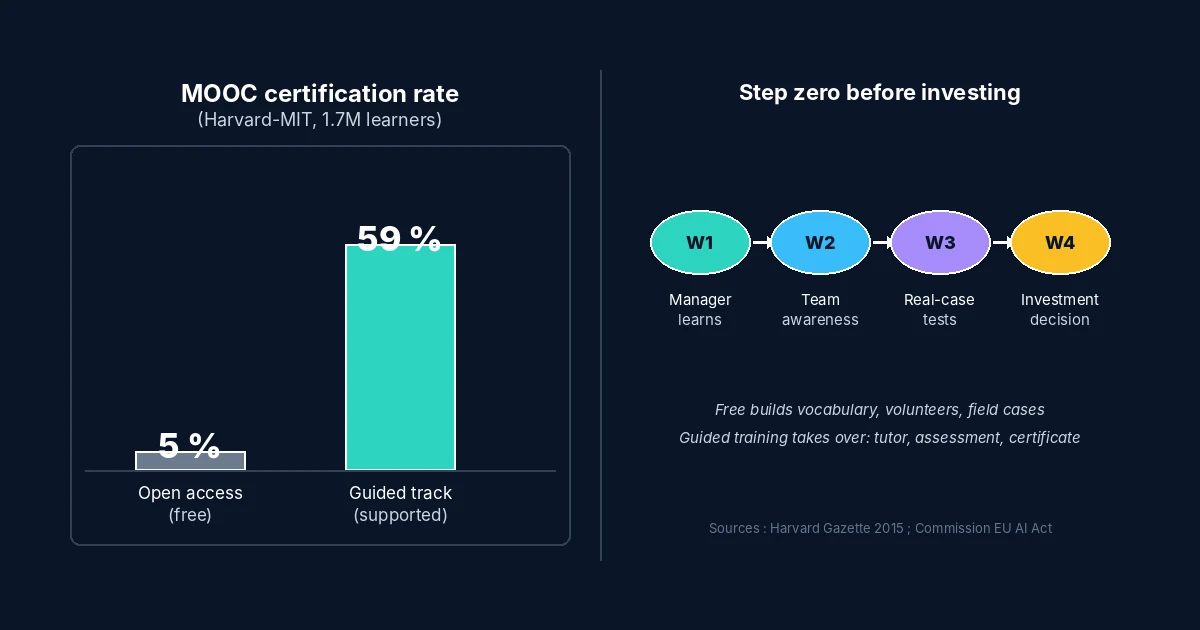
This is the central figure, documented by the joint Harvard–MIT study of 1.7 million learners: MOOC certification rates sit between 2 and 10% of enrolled learners, and across 12 compared courses, verified-track participants earned their certificate at 59% on average versus 5% in open access ([Harvard Gazette, 2015]). With identical content, guidance multiplies completion tenfold. For employees with no protected time slot and no tutor, expect the vast majority never to finish — treat free as awareness, never as guaranteed upskilling.
2. No grounding in your processes and tools
A MOOC teaches AI in general; it never teaches your ERP, your routings, your quality data. Yet that is where return on investment is decided: our guide to structuring in-company AI training shows job grounding is the number-one selection criterion. Free gives you the vocabulary — never the working gesture.
3. No traceability for the literacy obligation
Since 2 February 2025, Article 4 of the AI Act requires companies deploying AI to take AI literacy measures for their staff ([European Commission]). An employee who watched three videos one evening does not constitute a demonstrable measure: with no attendance record, no assessment and no certificate, free produces no evidence of compliance. This is the most underestimated legal limit.
4. No practice on your data, hence no use case
McKinsey measured it inside companies: 9 out of 10 participants recognised the value of formal training, yet 7 out of 10 ignored the onboarding videos, preferring learning through experience ([McKinsey]). Free is consumed like documentation. Until an employee has applied AI to a real file from your company, nothing operational has happened.
5. No collective momentum
Training three isolated volunteers on three different free MOOCs produces three different cultures — and zero shared language. In an industrial SME, where a production team, a methods office and management must understand each other, one short synchronised training session is worth more than ten individual free tracks. Free disperses; investment aligns.
The method: using free as step zero (4 weeks)
Rather than opposing free and paid, sequence them. Here is a realistic plan for an SME of 20 to 250 employees.
Week 1 — The manager trains first (3 hours)
Follow "À la recherche de l'IA" (FUN MOOC, 3 hours) or the first Elements of AI modules yourself. Goal: acquire the vocabulary (model, prompt, data, hallucination) to frame what follows with full knowledge. A manager who has never handled an AI tool can neither select a provider nor assess a proposal.
Week 2 — Light collective awareness (1 hour)
Offer the team a short shared resource — for example the Elements of AI introductory modules or a guided group session with a generative assistant on a neutral case (meeting minutes, document summary). Goal: spot motivated volunteers — the Harvard–MIT study shows stated intent predicts completion ([Harvard Gazette, 2015]). Select volunteers for what follows, not draftees.
Week 3 — One real case, even rough
Ask each volunteer to apply a free tool to one real task of their job (a methods technician summarises a file, a salesperson drafts a report, a quality officer rewrites a procedure). Goal: produce the first field findings — what works, what blocks, where the data sits. These findings become the specification for the paid training.
Week 4 — Investment decision
With the vocabulary (week 1), identified volunteers (week 2) and tested cases (week 3), you can frame an investment: scope, measurable objective, budget. Our guide to choosing the right programme details the five criteria for that decision. The free step cost you one month and zero euros — and saved you a framing exercise most companies pay for through unsuitable training.
When free is no longer enough: the 4 signals
Move to guided training when at least two of these signals hold:
- You are deploying (or about to deploy) an AI tool in production — the literacy obligation (AI Act Art. 4) requires traceable measures, not watched videos.
- The need is collective — a whole team must step up on the same process (quality, maintenance, sales admin, design office).
- Volunteers are stalling — free tests created appetite but no installed usage: tutoring, pace and supervised practice are missing.
- You must prove — a customer, auditor or insurer asks for training records: only a traceable programme counts.
At this stage, the right investment is not "more content" but a programme your employees will finish and apply: content grounded in your processes, a real tutor, assessment, certification. That is exactly what our AI training programmes are designed for — needs audit, training on your cases, deployment preparation. Our training is bespoke work, quoted after scoping: we offer neither free training nor guaranteed funding, and we say so plainly so your investment decision rests on sound ground.
FAQ
Is free AI training enough to meet the AI Act literacy obligation?
No, except under a specific arrangement. Article 4 of the AI Act, applicable since 2 February 2025, requires deployers of AI systems to take literacy measures for their staff ([European Commission]). Free can be one awareness brick, but without traceability (attendance, assessment, certificate) it produces no demonstrable evidence under scrutiny.
What is the best free MOOC to start with in a company?
For manager and support-function awareness with no technical prerequisites, Elements of AI (University of Helsinki, over one million participants, 26 languages) is the documented reference ([University of Helsinki]). For hands-on generative tools by job role, in French, the Cnam "Pratiquer l'IA utile" MOOC on FUN (3 weeks, ~5 hours) is the most operational ([FUN MOOC]).
Why are free MOOC completion rates so low?
Because the obstacle is not content but guidance: the Harvard–MIT study of 1.7 million learners shows 5% certification in open access versus 59% in verified guided tracks, with identical content ([Harvard Gazette, 2015]). With no tutor, no imposed pace and no formal stake, online training is browsed like documentation, not followed like a programme.
Can free serve a whole production team?
As initial awareness, yes — provided you organise collective time (shared session, guided practice). As upskilling, no: shift teams, working gestures and traceability require a guided programme. Our analysis of online programmes details the traps of 100% remote for field teams.
How long should the free step last before investing?
Four weeks is enough (see the method above): one week for management, one for awareness, one for real-case tests, one for the decision. Beyond that, free becomes an alibi delaying useful investment — especially if you already run AI in production.
Conclusion: free informs the decision, it never replaces it
The right question is not "is free enough?" but "what must free teach me before I invest?": the vocabulary, the volunteers, the first field cases. With those three assets, your investment targets a framed need — and that is where a guided programme takes over: same teams, same processes, but with a tutor, an assessment and a certificate.
If your free tests revealed a concrete use case — quality, maintenance, sales admin, design office — the next step is professional scoping. Request an AI audit: we qualify the need, quote the training, and prepare deployment with your teams.