
Logistics automation: warehouse, order picking, traceability
Logistics automation in the warehouse: receiving, order picking, AMR robotics and SSCC traceability. AI use cases and sourced, measured gains. Request an audit.
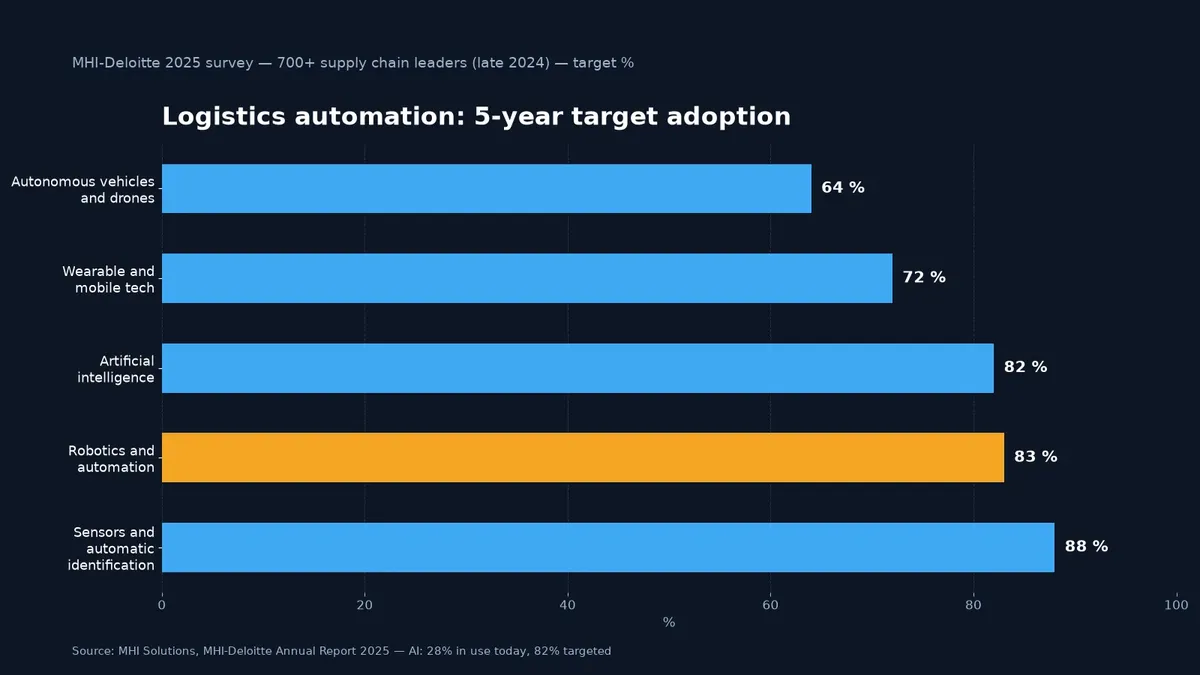
TL;DR: Logistics automation concentrates AI where the warehouse hurts most: labour and volumes. Hiring and retention worry 52% of supply chain leaders, talent shortage 45% (MHI-Deloitte 2025); 45% plan to buy automated solutions. The trajectory is set: 83% target robotics and automation within five years, 88% sensors and automatic identification — and Gartner predicted 75% of large enterprises equipped with smart intralogistics robots by 2026. This article gives you the use cases — receiving, order picking, traceability — the sourced measured gains, and the deployment method for an industrial or e-commerce warehouse.
90 monthly searches in France for « automatisation logistique » ([DataForSEO data, collected 28/09/2026]). Behind this focused volume, a concrete intent: SME and mid-cap leaders — manufacturers, distributors, e-retailers — who are not looking for a definition but for an answer to the question what can AI automate in my warehouse, and what does it pay back?
This article answers that question. It complements our overview of industrial automation — focused on production use cases — and our business process automation method — the how of automation, all processes combined — by covering a precise scope here: the warehouse, from goods receiving to shipping, through order picking and traceability.
Why logistics is automating now: volumes and labour
Two forces are converging on the warehouse, and both are measured.
Volume pressure. The Fevad 2024 review establishes it for France: online sales passed 175.3 billion euros, up 9.6% on 2023 ([Fevad, French e-commerce review 2024]) — a dynamic mirrored across European markets. Each point of e-commerce growth means order lines to pick, parcels to ship and returns to process — in warehouses whose floor space and teams have not grown at the same pace.
Labour constraints. The 12th MHI-Deloitte Annual Industry Report (late-2024 survey of 700+ supply chain leaders) is explicit: the top internal challenge remains the workforce, with hiring and retaining workers vexing 52% of leaders and a general talent shortage 45% ([MHI Solutions, "Digital Investments Cover End-to-End Supply Chains", June 2025]). The budget response follows: 55% of leaders increased their supply chain technology and innovation budgets, 45% plan to purchase automated solutions and 42% forklifts and handling equipment.
The five-year adoption trajectory, again per MHI-Deloitte, puts the warehouse at the centre: sensors and automatic identification 88%, robotics and automation 83%, artificial intelligence 82% — versus 28% using AI today — wearable and mobile technology 72%, autonomous vehicles and drones 64%. And in its technology outlook, Gartner predicted that 75% of large enterprises will have adopted some form of smart intralogistics robots in their warehouse operations by 2026 ([Material Handling 24/7, "Gartner: by 2026, three-fourths of large enterprises will adopt intralogistics smart robots", January 2022]). As analyst Dwight Klappich put it: "labour availability constraints" and "rapidly rising labour rates" will compel most companies to invest in cyber-physical systems, intralogistics smart robots first.
Receiving and inbound control: the dock as the first source of gains
Everything that enters the warehouse unchecked resurfaces later as an inventory gap, a supplier dispute or a stockout. Receiving automation acts on three levers.
Standardised identification of logistic units. The GS1 Serial Shipping Container Code (SSCC) uniquely identifies each logistic unit — case, pallet, parcel: SSCCs "are a crucial key for traceability, since they uniquely identify each distributed logistic unit and its content" and "enable companies to receipt deliveries more easily" ([GS1, "Serial Shipping Container Code (SSCC)"]). Scanned on arrival, the SSCC automatically matches the delivery against the advance shipping notice (DESADV/ASN) sent upstream: receiving becomes control by exception instead of full re-entry.
AI document reading. Non-standard delivery notes, material certificates, transport documents: document-understanding models extract lines, quantities, batches and dates, including from never-seen layouts. The quality effect is documented by the Garza et al. (2023) meta-analysis: an error rate falling from 6.57% to 0.14% in automated tasks, i.e. −98% ([Garza et al., 2023]). And companies that digitise with high technology acceptance see 75% fewer financial errors ([Gartner, February 2024]).
Purchase order — receipt — invoice matching. This is the junction with the back office: the system confronts the purchase order, the dock receipt and the supplier invoice, and only escalates exceptions. For the full chain — from mandatory e-invoicing to archiving — see our supplier invoice digitalisation guide.
Storage and order picking: the heart of logistics automation
Order picking is the most labour-intensive job in the warehouse: operators walking aisles, picking items and consolidating them — with seasonal peaks requiring teams to double within weeks. Three automation layers combine here.
| Layer | What AI automates | Example |
|---|---|---|
| Control (WMS) | Optimal slotting, wave scheduling, pick routing | Dynamic slotting by item rotation |
| Mobile robotics (AMR) | Load transport, goods-to-person, piece picking | Pallets brought to the operator, not the reverse |
| Vision and control | Pick guidance, parcel compliance checks | Item and quantity verification before sealing |
Smart control first. Before any robot, the warehouse management system (WMS) optimises slot assignment — fast movers near shipping zones — and sequences pick orders into waves that minimise travel. This is optimisation on your real data (order history, aisle plans): fast payback, no hardware required.
Mobile robotics next. Gartner describes the flexible use cases already available: transporting pallets of goods, delivering goods to a person (goods-to-person) or picking individual items — solutions that "can more readily and inexpensively be implemented, and can be easily scaled to better manage extremes in peaks and troughs of demand" ([Material Handling 24/7, January 2022]). Goods-to-person reverses the logic: the operator no longer walks to the stock, the stock comes to the operator — eliminating most travel time, the leading source of non-value-added work in picking.
Equipment maintenance is not forgotten. Conveyors, stacker cranes, forklifts: predictive maintenance on warehouse equipment follows the same fundamentals as in production — up to 50% fewer equipment outages and maintenance costs cut by 10 to 40% ([McKinsey Global Institute, "The Internet of Things", June 2015]). For detailed deployment — sensors, models, ROI — see our predictive maintenance guide.
Shipping, traceability and returns: closing the loop
End-to-end traceability rests on the unique identification described above: each shipped unit carries its SSCC, chained to the batches and serial numbers inside, and shareable electronically (EDI, EPCIS) with partners. GS1 states it directly: the SSCC "enables companies to share information about the status of logistic units in transit" ([GS1, "Serial Shipping Container Code (SSCC)"]). For regulated sectors — food, pharma, batteries — this item-batch-parcel traceability is the compliance infrastructure: targeted recall instead of blind recall, proof of origin on demand.
Technology appetite follows: 88% targeted five-year adoption for sensors and automatic identification (MHI-Deloitte 2025) — RFID gates at dock exits, automatic label reading, indoor pallet geolocation. Traceability data also feeds management: time spent collecting, validating and sharing data can be cut by 60 to 80% with the right investment ([Forrester, Total Economic Impact of Diligent ESG, July 2022]).
Returns, the blind spot of e-commerce, are handled as a flow of their own: automated sorting on return receipt (resell as-is, refurbish, scrap), real-time restocking, reason-code analysis feeding back to product pages. A return processed in 48 hours with immediate relisting does not cost the same as one sleeping three weeks in a dispute zone.
The measured gains of logistics automation
All figures below come from independent studies, verified verbatim. They are orders of magnitude observed at comparable organisations — your payback is computed on your volumes, floor space and labour costs.
| Measured gain | Scale | Source |
|---|---|---|
| Large enterprises equipped with intralogistics robots (2026 horizon, forecast) | 75% | Gartner, Predicts 2022 |
| Targeted 5-year adoption: robotics and automation | 83% of leaders | MHI-Deloitte, 2025 report |
| Targeted 5-year adoption: sensors and automatic identification | 88% of leaders | MHI-Deloitte, 2025 report |
| Leaders planning to buy automated solutions | 45% | MHI-Deloitte, 2025 report |
| Data-entry errors (automated tasks) | 6.57% → 0.14% (−98%) | Garza et al., 2023 |
| Financial errors (digitised environments) | −75% | Gartner, February 2024 |
| Data collection and validation time | −60 to −80% | Forrester, TEI July 2022 |
| Equipment outages (predictive maintenance) | up to −50% | McKinsey Global Institute, 2015 |
| French e-commerce 2024 (volume context) | €175.3bn, +9.6% | Fevad, 2024 review |
Where to start: the four-pilot method
Logistics automation fails when it starts with hardware. It succeeds when it starts with data and a measured scope — the same logic as our process automation method and our AI audit.
- Map real flows: volumes by family, seasonality, travel times, picking error rates, supplier dispute costs. Without this picture, no ROI can be computed.
- Pilot 1 — receiving: SSCC + automatic matching on your top three suppliers. Controlled scope, immediate effect on inventory gaps.
- Pilot 2 — picking: optimised slotting and waves in the WMS, then goods-to-person in a fast-moving zone. Measure time per pick line before/after.
- Pilot 3 — traceability: unique batch-case-pallet identification and EPCIS sharing with one pilot customer. Compliance becomes a by-product of the flow, not a parallel project.
Each pilot is judged on your real data: pick lines per hour, error rates, receiving lead times, cost per parcel shipped. That is exactly what an AI audit frames: scope, available data, measurable gains — before any hardware investment.
FAQ
Does logistics automation replace order pickers?
No: it moves their work up the value chain. Robots transport and bring stock to the operator, who controls, picks exceptions and handles disputes — in a context where 52% of leaders already struggle to hire and retain (MHI-Deloitte 2025). Automation offsets shortage more than it removes filled positions.
How does it differ from industrial automation?
Industrial automation acts on production — maintenance, quality control, planning (see our overview). Logistics automation acts on flows — receiving, storage, picking, shipping, traceability. Both share the same building blocks (vision, prediction, robotics) but not the same scopes or indicators.
Do you need a WMS before robotising?
Yes, in most cases. The WMS (or an extended ERP) is the system that knows where each item is and schedules the work: without it, robots have no orders to execute. Optimised slotting and waves often pay back before the first AMR — and make later robotisation twice as effective.
What is the SSCC and why is it central to traceability?
The SSCC (Serial Shipping Container Code) is the GS1 identifier of each logistic unit — pallet, case, parcel. Unique and globally standard, it chains the unit to its content (batches, serials) and is shared electronically with partners: the parcel's "licence plate", from shipping to receiving.
What does warehouse automation cost?
There is no standard price: a WMS-slotting pilot runs in the tens of thousands of euros, an AMR fleet in the hundreds of thousands. The right question is the payback on your volumes — lines per hour, errors, seasonal peaks. A prior audit prices it on your data before any hardware commitment.
Conclusion: the warehouse as a measurable asset
Logistics automation is neither a robotics gadget nor an IT project: it turns the warehouse into a measurable asset — every receipt controlled, every pick line timed, every parcel traced. E-commerce volumes (+9.6% in France in 2024) and labour shortage (52% of leaders affected) make it a necessity investment; adoption trajectories (83% for robotics within five years) show the first-mover window is closing.
Start with mapping and a receiving pilot: the fastest scope to measure and the most visible in inventory. Request an audit — we price the opportunity on your real flows before any investment.